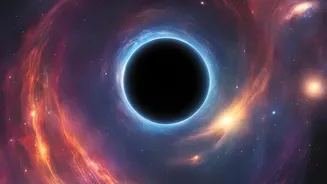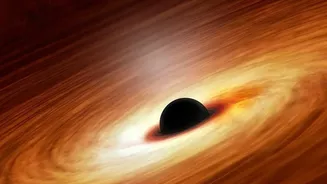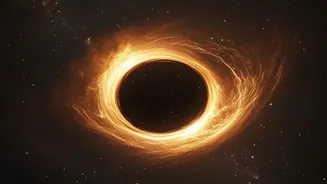




Black holes are famous for pulling things in, not letting them out. But what if one could split in two? Scientists are actively exploring this mind-bending possibility, pushing the laws of physics to their absolute limits.
The Unbreakable Cosmic Rule
At the heart of our understanding
of black holes is the event horizon: the ultimate point of no return. Once matter or light crosses this boundary, it cannot escape the immense gravitational pull. This one-way-trip nature is a cornerstone of general relativity. The laws of thermodynamics also seem to prevent a split. For a stationary black hole, splitting into two smaller ones would decrease its total entropy—a measure of disorder. In simple terms, this is a process that is not supposed to happen spontaneously, as the universe naturally tends toward more disorder, not less. This fundamental barrier has long suggested that black holes are stable, merging when they meet but never breaking apart on their own.
A Theoretical Loophole in Spacetime
Physics, however, loves to find loopholes. One of the most fascinating ideas is the 'cosmic censorship hypothesis', which posits that the singularity at the center of a black hole must always be hidden behind an event horizon. If a singularity were to exist without an event horizon, it would be 'naked', and the laws of physics as we know them would break down. Some theories suggest that if a black hole spins fast enough—at its absolute maximum possible speed—its event horizon could become unstable. This exceptionally extreme condition could, in theory, allow the black hole to deform and split, forming what scientists have nicknamed a 'pair-of-pants' shape in spacetime, with two new black holes emerging from the 'legs'.
The Search for a Cosmic Split
Recent theoretical work, published in the journal Physical Review D, has explored the specific conditions required for such a split to occur. According to researchers, the loophole created by extreme rotation is incredibly narrow. Not only must the black hole spin at its physical limit, but the resulting two smaller black holes must be able to move apart fast enough to avoid immediately falling back together and merging again. The study mentioned in the headline refers to the ongoing effort to find evidence of such events. Scientists analyze data from gravitational wave observatories, which detect ripples in spacetime caused by massive cosmic events like black hole mergers. A black hole division would produce a unique gravitational wave signature, one that has never been confirmed.
What 'No Observation' Really Means
Finding no confirmed evidence of a dividing black hole is not a failure; it is a significant scientific result. Each time an extreme prediction is tested and not observed, it strengthens our existing models of the universe. In this case, the lack of observation reinforces the robustness of Albert Einstein's theory of general relativity and principles like the cosmic censorship hypothesis. It suggests that, even under the most extreme conditions imaginable, the universe continues to play by a set of consistent rules. While some research has disproven the 'strong' version of the cosmic censorship conjecture in idealized mathematical scenarios, the 'weak' version—that singularities remain hidden from distant observers—continues to hold up to scrutiny. This ongoing verification is crucial for ensuring that our understanding of gravity is correct.
The Hunt Is Far From Over
While a splitting black hole remains, for now, in the realm of theory, the search itself drives progress. Scientists expect that smaller, primordial black holes might be more likely to split than the larger ones we typically observe. Detecting such an event might be possible indirectly, by searching for specific gamma-ray signals from tiny black hole fragments. The quest to find violations or extreme tests of general relativity pushes astronomers and physicists to build more sensitive instruments and refine their theories. Future gravitational wave observatories and telescopes will continue to scan the cosmos for these and other exotic phenomena, constantly testing the boundaries of our knowledge and searching for the next great breakthrough in our understanding of gravity and the universe.