

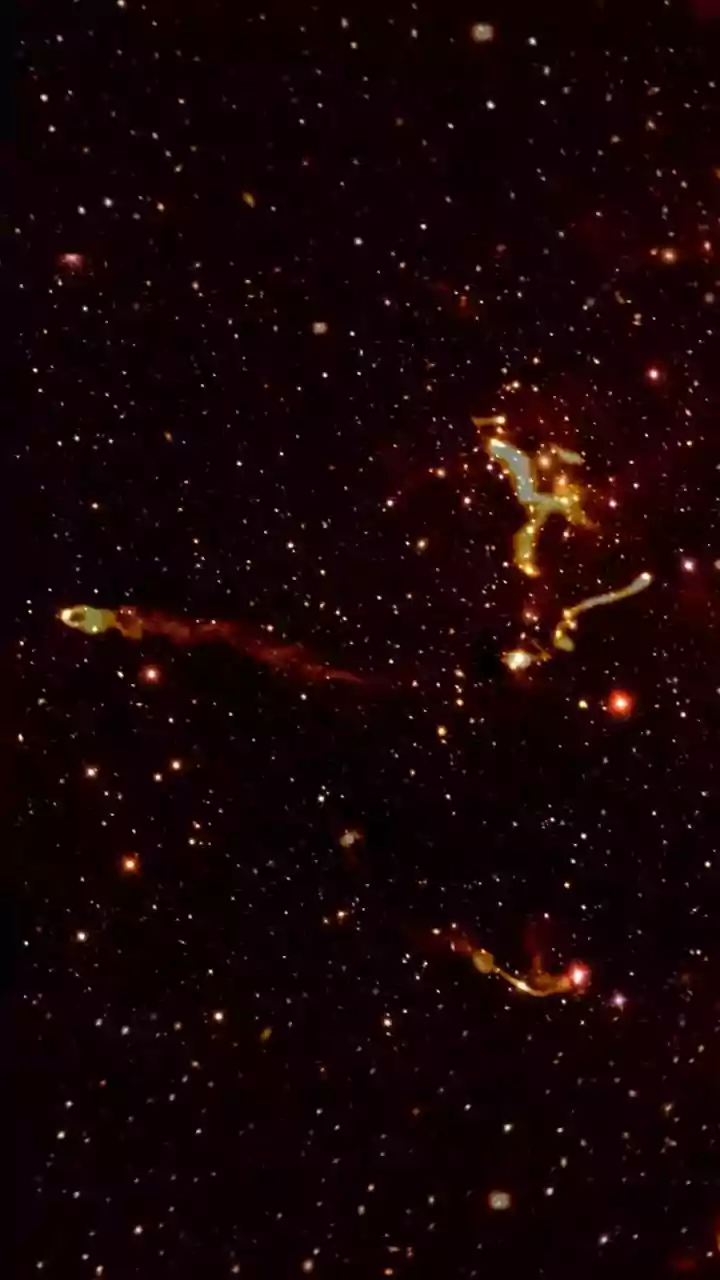





The outer solar system is our home's vast, dark backyard, filled with ancient mysteries. A new discovery by the powerful Rubin Telescope, a candidate dwarf planet dubbed 2026 ED138, is peeling back another layer of that darkness.
A New Neighbor in the Darkness
Astronomers have found
what may be a new dwarf planet hiding in the frigid depths of our solar system, far beyond the orbit of Neptune. Provisionally named 2026 ED138, this object is a trans-Neptunian object, or TNO. TNOs are a vast population of icy and rocky bodies that circle the Sun in a region called the Kuiper Belt. Think of them as frozen time capsules, perfectly preserved remnants from the birth of our solar system 4.6 billion years ago. Because they have changed very little since their formation, studying them provides a crucial window into the conditions when the planets were first growing. Based on its brightness, scientists estimate 2026 ED138 is between 600 and 1,500 kilometres across. If it's on the larger end of that scale, its own gravity would have pulled it into a nearly round shape, a key requirement for it to be officially classified as a dwarf planet, joining the ranks of Pluto and Eris.
The Revolutionary Eye on the Sky
This discovery was made possible by the Vera C. Rubin Observatory, a brand-new facility perched on a mountaintop in Chile. The observatory, which began its formal 10-year survey in June 2026, is an unparalleled machine for scanning the cosmos. It boasts the world's largest digital camera—a staggering 3.2 gigapixels—allowing it to capture huge swathes of the sky with incredible detail. Its mission, the Legacy Survey of Space and Time (LSST), will image the entire southern sky every few nights. This creates a massive time-lapse movie of the universe, making it uniquely skilled at spotting faint objects that move or change. Spotting 2026 ED138 was a particular triumph because it was found near the crowded plane of the Milky Way, where countless background stars make it easy for a distant, slow-moving object to hide.
Clues to Our Cosmic History
Finding one new object, even a large one, is exciting, but its true value lies in what it adds to the collective picture. Every new TNO helps scientists piece together the grand puzzle of our solar system's evolution. The orbits, sizes, and compositions of these distant worlds hold clues about how the giant planets like Jupiter and Neptune may have migrated long ago, scattering smaller objects in their wake. Interestingly, after spotting 2026 ED138 in recent data, astronomers were able to find it hiding in archival images from other telescopes dating back a full decade. This ability to 'precover' an object allows for a much faster and more accurate calculation of its long-term orbit, a crucial step in understanding its history.
The Search for Planet Nine Continues
Discoveries like this also feed into one of the most exciting astronomical mysteries today: the hunt for Planet Nine. This hypothetical, massive planet is thought to exist in the far outer solar system. Its presence was first inferred from the strangely clustered orbits of several other distant TNOs—orbits that seem to be shaped by the gravity of a large, unseen world. While 2026 ED138 doesn't by itself prove Planet Nine exists, every new object cataloged provides another data point. As the Rubin Observatory discovers thousands more TNOs over the next decade, astronomers will build a detailed map of these objects' orbits. This comprehensive survey will either strengthen the case for Planet Nine by revealing more objects following the predicted pattern or potentially rule it out.