




A Lone Sentinel in the Darkness
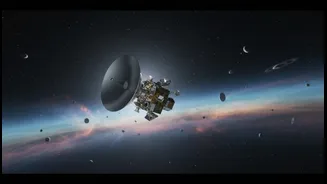
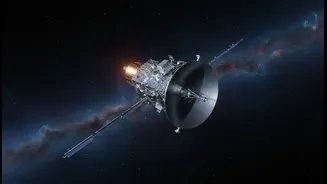
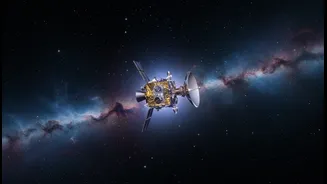
Launched in 2006, New Horizons is one of humanity's most ambitious explorers. After a nine-year journey, it gave us our first close-up look at Pluto in 2015, revealing a world of nitrogen glaciers and ice mountains. But its mission didn't end there. It
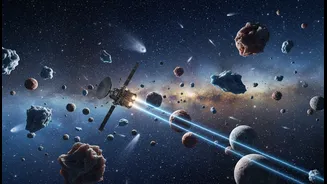
pressed onward into the Kuiper Belt, a vast, donut-shaped region of icy bodies left over from the formation of the solar system. In 2019, it made history again by flying past Arrokoth, the most distant and primitive object ever explored by a spacecraft. Since then, it has been cruising through this frozen frontier, acting as our eyes and ears in a region no other active mission is exploring.
The Solar System's Frozen Attic
Think of the Kuiper Belt as the solar system's deep freeze or cosmic attic. It begins beyond the orbit of Neptune, about 30 times farther from the Sun than Earth is, and is packed with millions of icy objects. These aren't just random space rocks; they are pristine relics from over 4.5 billion years ago, holding secrets about how planets like Earth came to be. Before New Horizons, our maps of this region were based on distant observations from telescopes like Hubble. We knew it was there, but the details were fuzzy, like looking at a distant shoreline through thick fog.
A Signal from the Void
The recent "awakening" refers to NASA bringing the probe out of a long, resource-saving hibernation mode on July 7, 2026. While some of its instruments kept gathering data on the dust and plasma environment during its 321-day sleep, the main event is now beginning. With the spacecraft fully active, it will start transmitting all the stored data. This isn't an instantaneous process; the probe is so far away that a radio signal, travelling at the speed of light, takes nearly nine hours to reach Earth. This treasure trove of new information, gathered from a region we've never sampled so directly, is what scientists are eagerly awaiting.
Redrawing the Cosmic Map
The information from New Horizons is already challenging our existing maps. For years, scientists thought the Kuiper Belt ended around 50 astronomical units (AU) from the Sun (50 times the Earth-Sun distance). New Horizons has flown past that boundary and is still detecting more cosmic dust than expected. This suggests the belt is much larger than previously thought, or that there might even be a second, more distant Kuiper Belt. As the probe continues to collect data on the distribution of these Kuiper Belt Objects (KBOs), it provides concrete data points that either confirm or contradict our models. This allows astronomers to refine their maps, moving from educated guesses to observation-backed charts of this distant realm.
Why This Frozen Frontier Matters
Mapping the Kuiper Belt isn't just an academic exercise. Understanding the structure and scale of this region is fundamental to understanding our own origins. The arrangement of these icy bodies provides crucial evidence for how our solar system's giant planets, like Jupiter and Neptune, migrated to their present positions, a process that profoundly shaped the entire system. Furthermore, the Kuiper Belt is the source of many short-period comets. A more accurate map helps us understand the inventory of these objects. Every piece of data from New Horizons helps piece together the grand puzzle of planetary formation, not just in our solar system, but in the thousands of exoplanetary systems we now see across the galaxy.