





The Promise of a New World
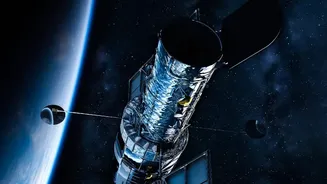
Our story begins with NASA's Transiting Exoplanet Survey Satellite, or TESS. This powerful space telescope is on a mission to scan the skies, looking for tiny, rhythmic dips in the brightness of distant stars. These dips are often the tell-tale sign of a planet passing
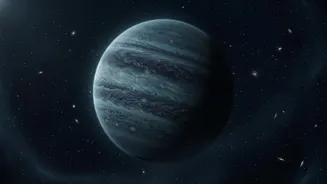
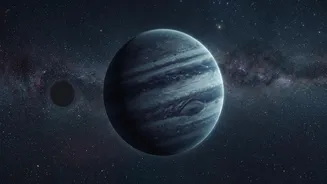
in front of its star from our perspective, an event known as a transit. It was during one of these surveys that TESS flagged a potential planet orbiting a star roughly 800 light-years away, giving it the designation TOI-2535 b. The transit method is our most successful tool for finding exoplanets, but it has a built-in requirement: orbital alignment. For TESS to see a planet, its orbit must be almost perfectly edge-on with our line of sight. If the planet's path is tilted even slightly, it will never pass in front of its star from our viewpoint, and it will remain invisible to this detection method.
The Case of the Vanishing Planet
A TESS detection is just the first step; it's a candidate, not a confirmation. To verify the existence of a planet, astronomers turn to other methods. A major follow-up effort, the TESS-Keck Survey, used the immense power of the Keck Observatory in Hawaii to take a closer look. Instead of looking for a dip in light, Keck uses the 'radial velocity' method, which searches for a tiny 'wobble' in the star's movement. This wobble is caused by the gravitational tug of an orbiting planet. It's a bit like watching a person walking a large, unseen dog on a leash; you can't see the dog, but you can see its owner being pulled around. But when the Keck team pointed their instruments at the star TOI-2535, they found nothing. There was no discernible wobble, no gravitational tug. The planet that TESS's data suggested was there, was simply not showing up. From Keck's perspective, TOI-2535 b was missing in action.
An Elegant, Complicated Explanation
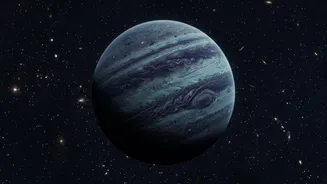
So, did the planet suddenly tilt its orbit and disappear? Not exactly. The initial transit detection already confirmed its alignment was correct. The discrepancy between the two methods points to more nuanced possibilities. One leading theory is that TOI-2535 b is simply too small for its gravitational pull to be measured by our current instruments. It might be a low-mass world, a 'ghost' in the data whose transit is visible but whose gravitational signature is too faint for even the mighty Keck telescope to feel. Another possibility is that the original TESS signal was a 'false positive'. Stellar phenomena like large starspots or flares can sometimes mimic the dimming effect of a transiting planet, fooling the algorithms designed to find them. The science team concluded that they could not confirm a planet and could only place an upper limit on its possible mass, leaving its true nature a mystery.
Why This Changes Our Search
Cases like TOI-2535 b are not failures; they are fundamental to the scientific process. They serve as crucial reality checks on our methods and assumptions. Each 'missing' planet helps astronomers refine their techniques, teaching them to better distinguish a faint planetary signal from background noise. It highlights the immense challenge and rigor involved in confirming the existence of a world hundreds of light-years away. Discovering a planet is not a single 'eureka' moment but a painstaking process of observation, verification, and elimination. These puzzles force innovation, pushing engineers to build more sensitive instruments and encouraging theorists to develop better models of planetary systems. This single non-detection provides valuable data that will inform the search for countless other worlds and help us understand the limits and potential of our technology.