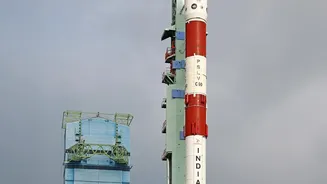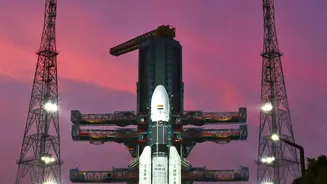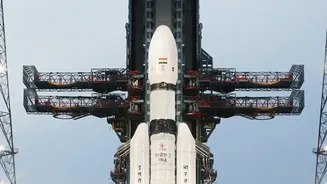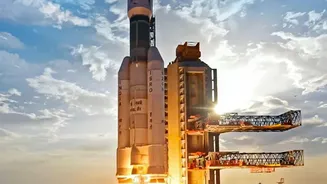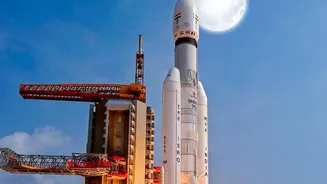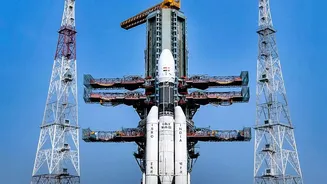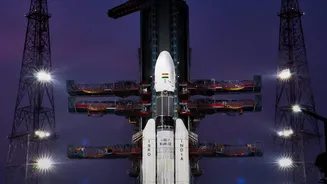


Meet Pushpak, India’s Space Shuttle
Imagine a vehicle that launches like a rocket but lands on a runway like an airplane. That's the core concept behind ISRO's Reusable Launch Vehicle (RLV) program, and its star is a winged technology demonstrator named Pushpak. This vehicle is the cornerstone
of India's ambition to create a Two-Stage-To-Orbit (TSTO) launch system. In this model, the first stage would fly back to Earth after launch, while the second stage, Pushpak, would proceed to orbit, deploy a satellite, and then glide back for a conventional runway landing. This reusability is the key to drastically cutting the cost of accessing space.
Nailing the Landing: A Series of Crucial Tests
For any reusable vehicle, the most challenging part is returning safely to Earth. ISRO has been methodically testing this critical phase through a series of Landing Experiments (LEX). In these tests, an Indian Air Force Chinook helicopter lifts Pushpak to an altitude of 4.5 kilometres. From there, the vehicle is released to perform an autonomous landing. The most recent tests have been increasingly complex, forcing Pushpak to correct its path from off-nominal release positions and in challenging wind conditions to find the runway and land with precision. The successful completion of three such tests demonstrates ISRO's mastery over the autonomous navigation, guidance, and control systems required for this feat. The landing speed, at over 320 kmph, is faster than that of a commercial aircraft, highlighting the technical difficulty involved.
The Billion-Rupee Question: How Reusability Slashes Costs
Traditional rockets are expendable; the most expensive components, like the main engines and complex avionic systems, are used only once before being discarded. This is like building a brand-new airplane for every single flight. Reusable launch vehicles change this paradigm entirely. By recovering and reflying the costliest parts of the rocket, the manufacturing cost is spread across multiple missions. ISRO's goal with the RLV program is to reduce satellite launch costs by a significant margin, with some estimates suggesting a potential reduction of up to 80 percent. This dramatic cost reduction is not just a minor saving; it's a game-changer that makes space access more affordable for a wider range of applications, from communication and navigation to scientific research.
Boosting India’s Place in the Global Space Market
Lowering launch costs does more than just save money on individual missions. It makes India an incredibly competitive player in the multi-billion dollar global satellite launch market. As the demand for satellite constellations grows, launch providers who can offer reliable and affordable services will dominate. Success with the RLV will enable ISRO to increase its launch frequency, serving both national needs and international customers more effectively. While ISRO officials maintain that their program is driven by national needs rather than competition with private entities like SpaceX, the capability itself is a statement of strength and technological prowess on the world stage. This technology also fosters a more sustainable approach to space exploration by reducing the amount of debris left in orbit or discarded in oceans.
The Path Forward: From Landing to Orbit
The successful landing experiments are just the beginning. Having proven the autonomous landing capability, ISRO's next major step is the Orbital Re-entry Experiment (ORE). This will involve launching a vehicle into orbit and having it autonomously re-enter the atmosphere and land on a runway. This next phase will test the vehicle's thermal protection systems, which must withstand the extreme heat of re-entry. The lessons learned from the Pushpak demonstrator will be instrumental in developing India's Next Generation Launch Vehicle (NGLV), envisioned as a partially reusable, heavy-lift rocket that will be the future workhorse of India's space program.