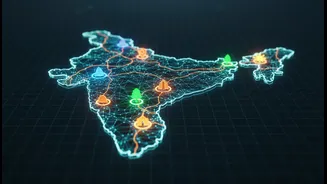









A New Guide for Tourists
Andhra Pradesh recently announced it aims to become India's first AI-powered tourism state. Through a partnership with tech company Explurger, the state is deploying an AI platform called NiVU at over 100 tourist destinations. Visitors can simply scan
a QR code at a temple, fort, or beach to interact with an AI guide via voice or text. The service, which requires no app download, provides information on the history and cultural significance of the site in over 130 languages. After a successful pilot at temples in Mangalagiri, the first phase will cover 30 major locations.
More Than Just Translation
This initiative is about more than just direct translation; it's a step toward creating context-aware technology. The goal is to provide information that is not only linguistically accurate but also culturally and historically relevant to each specific site. For a country as diverse as India, where dialects and cultural nuances change every few kilometers, this is a significant challenge. Standard AI models, often trained on English-centric data, struggle with the complexities of Indian languages, including code-switching (mixing English and a regional language), varied scripts, and a lack of digital data for many dialects. The Andhra Pradesh project signals a shift towards smaller, specialized AI systems trained for local needs.
The Challenge of a Billion Voices
Building effective voice AI for India is one of the toughest challenges in the tech world. The country has 22 official languages and hundreds of dialects, many of which have a limited digital footprint, making it difficult to source the vast amounts of data needed to train AI models. This data scarcity is a major hurdle. Furthermore, real-world spoken language in India is a fluid mix of languages and accents, a phenomenon that most global AI systems are not built to handle. Successfully deploying a tool like Andhra Pradesh's requires a focus on what is called 'vernacular intelligence'—the ability for AI to understand language as it's actually spoken, with all its regional flavour.
Forging a Hyper-Local Future
The Andhra Pradesh model reveals the path forward: AI must become more localized. Instead of relying on a single, massive model, the future likely involves developing systems trained on curated, high-quality local data. This approach helps preserve linguistic nuances and provides more accurate, culturally relevant interactions. For businesses, this trend opens up new opportunities to connect with a largely untapped market of non-English speakers, which accounts for over 90% of the population. The platform in Andhra Pradesh will also provide the tourism department with real-time analytics on visitor preferences and travel patterns, enabling data-driven planning. This demonstrates how localized AI can create a feedback loop that improves services over time.
An Engine for Inclusion and Growth
Ultimately, the implications of localized voice AI extend far beyond tourism. It’s an inclusion platform. By breaking down language and literacy barriers, voice technology can make essential services like banking, healthcare, and education more accessible to millions. For a 'spoken-first' society like India, voice is not just an alternative interface; for many, it is the primary one. Projects like the one in Andhra Pradesh are not merely technological showcases. They serve as a proof of concept for a more inclusive digital future, where technology adapts to human diversity, not the other way around. It shows how AI can be a tool for economic growth and cultural preservation simultaneously.