




A Famous Geometric Marvel
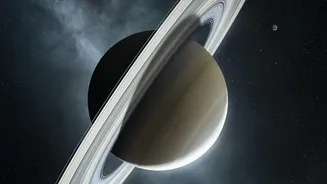
First spotted in data from the Voyager flybys in the 1980s, Saturn's northern hexagon is an atmospheric phenomenon that has captivated scientists. It is a remarkably stable, six-sided weather pattern wider than two Earths. This jet stream, with winds
whipping around at high speeds, has maintained its distinct shape for decades, a perplexing feat in the turbulent atmosphere of a gas giant. While hurricanes on Earth last for weeks, Saturn's hexagon has persisted through every observation since its discovery. This long-term stability led many to believe it was a one-of-a-kind feature, a unique fluke of the northern jet stream. For years, despite searching, scientists found no similar structure at the south pole.
The Surprise at the South Pole
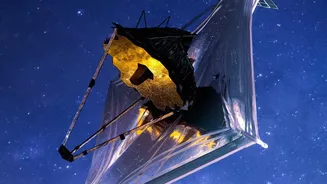
The game changed recently. Thanks to Saturn's slow seasonal tilt, its southern pole, which was hidden from Earth's view for years, has become visible again. This new vantage point led to a stunning discovery announced by scientists using the Hubble Space Telescope: a massive, 10-sided pattern, or decagon, has formed around the south pole. The discovery, detailed in the journal Science Advances, was a genuine surprise. NASA's Cassini spacecraft, which orbited Saturn from 2004 to 2017, saw no hint of such a long-lived structure. By analysing Hubble images going back to 2023, researchers found that this decagonal wave only began emerging recently, strengthening over the past few years.
Hexagon vs. Decagon: A Tale of Two Poles
While both poles now host a polygon, they are not identical twins. The northern hexagon is famously stable, almost locked in place relative to the planet's rotation. In contrast, the new southern decagon is a more dynamic, evolving feature. It appears to be strengthening and drifts slowly eastward. This gives scientists a rare opportunity to watch a giant atmospheric pattern in the process of forming, something the long-established hexagon never allowed. One leading theory suggests these shapes are formed by meandering waves in atmospheric jets. The difference between six and ten sides may be linked to variations in wind structure, latitude, or the influence of other nearby storms.
What the New Shape Reveals
The existence of a second, different polygon tells scientists that the hexagon is not as unique as once thought. It shows that such large geometric patterns can form in the atmospheres of gas giants under the right conditions, which helps advance our general understanding of meteorology. The fact that the decagon appeared so recently highlights how changeable these distant worlds can be. Researchers are particularly interested in a large anticyclone vortex, a sort of smaller cousin to Jupiter's Great Red Spot, that is churning near the decagon. Some simulations suggest this storm may be involved in triggering or sculpting the 10-sided wave.