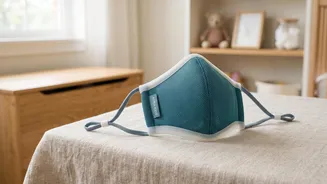




Rethinking Children's Masks
For a long time, any face covering was considered a sufficient step. However, with evolving health challenges, including airborne viruses and seasonal air pollution, the focus has shifted from mere covering to effective protection. The key difference
lies in two words: filtration and fit. Simple cloth masks, especially single-layer or homemade versions, and standard surgical masks often fall short on one or both of these fronts. While they can block larger droplets from a cough or sneeze, their ability to filter fine airborne particles is limited. Furthermore, they frequently leave gaps around the nose, cheeks, and chin, allowing unfiltered air to be inhaled and exhaled.
The Trouble with Cloth Masks
Cloth masks became a popular, reusable option, but their effectiveness varies dramatically. Studies have consistently shown that particle penetration is much higher in cloth masks compared to their medical-grade counterparts. The weave of most fabrics is simply too porous to block very small aerosol particles effectively. While multi-layer cloth masks can improve performance, they still rarely match the filtration standards of certified respirators. For a child, an ill-fitting cloth mask that gaps at the sides offers a false sense of security, providing minimal real-world protection against fine particles from pollution or viruses.
Surgical Masks: A Step Up, But Not Perfect
Disposable surgical masks offer better filtration than most cloth options because they are typically made with non-woven materials designed to block pathogens. However, their primary weakness, especially for children, is fit. Most surgical masks are designed for adult faces and are difficult to seal properly on a smaller face, leading to significant gaps. Even when knotting the ear loops and tucking the sides, achieving a snug fit without leaks can be challenging. These gaps can dramatically reduce the mask's effectiveness, as air will follow the path of least resistance, flowing in and out through the sides rather than through the filtering material.
The Expert Consensus: Higher Filtration is Key
Given these limitations, many paediatric experts in India now recommend higher-filtration masks, like certified N95, KN95, or FFP2 respirators, for children when protection is critical, such as during periods of high air pollution or rampant viral transmission. These respirators are designed to filter at least 95% of airborne particles and, crucially, are engineered to create a tight seal on the face. It is essential to find versions specifically designed for children to ensure this seal can be achieved. Dr. Amit Gupta, a senior paediatrician, advises that parents should look for child-sized N95 or KN95 masks for children above the age of five or six. He and other experts caution against being swayed by colourful designs, emphasizing that certification and fit are what truly matter for safety.
How to Choose the Right Mask and Ensure a Proper Fit
Finding a high-'quality mask that your child will wear correctly is the ultimate goal. The most protective mask is one that is worn consistently and properly. Look for masks with an adjustable nose clip and soft ear loops or head straps. To check the fit,' ensure the mask fully covers the nose,' mouth,' and chin,' sitting snugly against the cheeks without visible gaps.' If your child's glasses fog up or you can feel air escaping from the edges,' the fit is not secure.' It's also important that the mask allows for comfortable breathing and doesn't require constant adjustment.' For younger children between two and five,' supervised mask use for short durations is advised,' and masks are not recommended for any child under two years old due to suffocation risks.'