




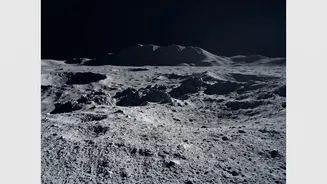
A Constant Barrage from Deep Space
Imagine microscopic bullets traveling at nearly the speed of light. That, in essence, is what cosmic rays are. They are not 'rays' in the typical sense, but rather highly energetic particles—mostly protons and atomic nuclei—originating from cataclysmic
events across the galaxy, like supernovae. These particles travel through space, and upon reaching Earth, they pose a significant threat. If they were to reach the surface unimpeded, their energy is potent enough to penetrate living tissue and strike the delicate machinery within our cells. This constant, invisible barrage would make life on the surface of our planet fundamentally untenable.
Earth's Planetary Force Field
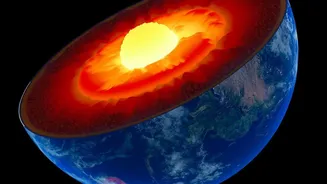
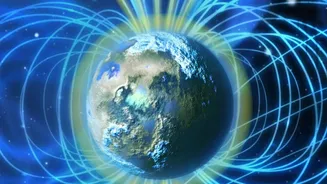
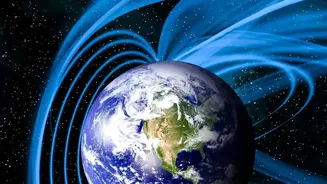
Fortunately, our planet has a built-in defense system: the magnetosphere. This vast, invisible magnetic bubble is generated deep within the Earth's core. The swirling motion of molten iron and nickel in the outer core creates powerful electric currents, transforming our planet into a gigantic magnet. This magnetic field extends tens of thousands of kilometers into space, creating a protective cavity that surrounds Earth. It is not a static sphere; the constant stream of charged particles from the Sun, known as the solar wind, stretches and shapes the magnetosphere, squashing it on the sun-facing side and drawing it out into a long tail on the night side.
The Great Deflection
The magnetosphere's power lies in its ability to deflect charged particles. Cosmic rays, being composed mainly of charged protons and nuclei, are susceptible to magnetic forces. As these particles approach Earth, they encounter the magnetic field lines of the magnetosphere. This interaction generates a force that alters their trajectory, pushing them away from the planet and causing them to flow around the magnetosphere much like water flows around a boulder in a stream. This deflection prevents the vast majority of cosmic rays from ever reaching the atmosphere or the ground. The beautiful auroras seen near the poles are a visible side effect of this process, occurring when some particles are funnelled down magnetic field lines and collide with atmospheric gases.
Guardian of the Genetic Code
This shielding is directly responsible for protecting the genetic integrity of life. A high-energy cosmic ray that penetrates a cell can damage DNA in two main ways. It can score a direct hit on the DNA molecule, physically breaking one or both strands of the double helix. Alternatively, it can ionize water molecules within the cell, creating highly reactive free radicals that then attack and scramble the genetic code. Such damage can lead to mutations. If the cell’s repair mechanisms fail, these mutations can cause the cell to die or malfunction, potentially leading to cancer or other diseases. By deflecting these particles, the magnetosphere drastically reduces the rate of radiation-induced mutation, providing the stable environment necessary for complex life to evolve and thrive over billions of years.
A Shield with Weak Points
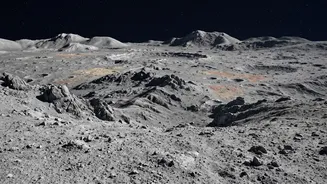
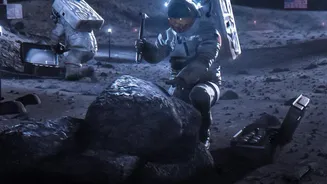
While incredibly effective, the magnetosphere isn't a perfect shield. The magnetic field is weaker at the poles, where some particles can get through. Furthermore, our atmosphere provides a crucial secondary layer of protection, absorbing particles that make it past the magnetic field. The magnetosphere also traps some charged particles in doughnut-shaped zones of radiation known as the Van Allen Belts. This is why astronauts in orbit, even when within the magnetosphere's broader protection, receive significantly higher radiation doses than people on the ground. For missions beyond Earth's orbit, such as to the Moon or Mars, protecting astronauts from cosmic rays remains a major scientific challenge.