



The Martian Air Problem
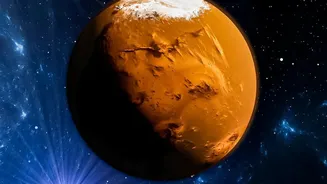
Before we can establish a foothold on the Red Planet, we have to solve the challenge of its atmosphere, which is about 96% carbon dioxide and has virtually no breathable oxygen. For astronauts to survive, they need a constant supply of O2. But the even
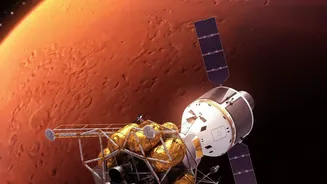
bigger demand comes from the journey home. A Mars Ascent Vehicle, the rocket that would lift a crew off the Martian surface, requires an enormous amount of liquid oxygen as a propellant—about 25 metric tons to burn roughly seven tons of fuel. Transporting all that oxygen from Earth would be incredibly expensive and complex, requiring multiple heavy launches and adding significant risk to any mission. The only viable long-term solution is to make it there, a concept known as In-Situ Resource Utilization, or ISRU.
A Toaster-Sized Proof of Concept
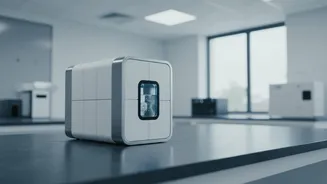
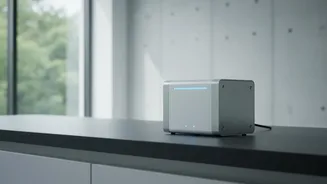
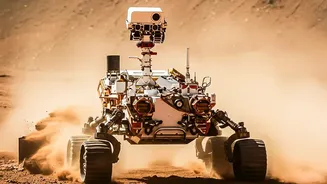
The first major step in proving this was possible came from a small, toaster-sized instrument aboard NASA's Perseverance rover. Called MOXIE (Mars Oxygen In-Situ Resource Utilization Experiment), this device was designed to do one revolutionary thing: pull in the carbon dioxide-rich Martian air and split it into oxygen and carbon monoxide. Using a process called solid oxide electrolysis, MOXIE heated the atmospheric gas to around 800°C and used an electrochemical process to separate the oxygen atoms from the CO2 molecules. Over its mission, which concluded in 2023, MOXIE successfully ran 16 times, proving it could work in different seasons and times of day. At its peak, it produced 12 grams of oxygen per hour—about what a small tree does on Earth, and double its original goal. MOXIE was a resounding success, demonstrating for the first time that we can manufacture breathable air on another planet.
The Critical Upgrade to a Full-Scale Factory
While MOXIE was a phenomenal proof of concept, its output was tiny—enough to keep an astronaut breathing for a few minutes, but not nearly enough for a mission. The headline-making progress lies in the "upgraded" technology that builds on MOXIE's success. Companies like OxEon Energy, which developed the core electrolysis stack for MOXIE, are now building mission-scale systems. These new-generation solid oxide electrolysis (SOXE) units are vastly more powerful. Recent developments have produced stacks that are scaled up 33 times compared to MOXIE's, featuring larger cells and more of them. The upgrades also include improved materials that enhance durability and operational stability, which is crucial for a system that will need to run continuously for months. This isn't just a bigger version of MOXIE; it's a more robust, efficient, and resilient system designed for a real-world Martian industrial plant.
What 'Scalable' Really Means for Mars
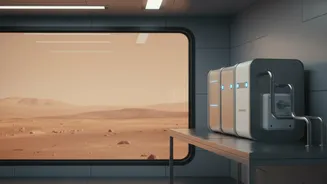
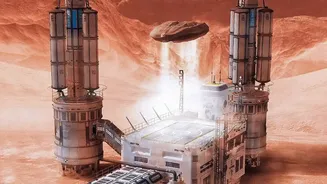
The jump from MOXIE to these new systems is what makes a human presence on Mars truly feasible. The term "scalable" refers to this leap in production capacity. While MOXIE topped out at 12 grams per hour, a single one of the new mission-scale stacks is designed to produce around 675 grams of oxygen per hour. A future oxygen plant on Mars would likely consist of an array of these units. For example, a set of six of these advanced stacks could generate the 30 tons of liquid oxygen needed for a Mars Ascent Vehicle within about 19 months. That's enough to fill the propellant tank for the ride home while the crew is still en route to Mars. This level of production moves oxygen generation from a small science experiment to a core piece of mission infrastructure, capable of supporting both life support and transportation needs.
Unlocking the Red Planet for Humanity
This upgraded electrolysis technology is more than just an impressive piece of engineering; it's a key that unlocks the door to a sustainable human future on Mars. By learning to "live off the land," future missions can drastically reduce their launch mass, cost, and complexity. Instead of being entirely dependent on a fragile supply chain stretching across millions of miles of space, astronauts will be able to produce their most critical consumable on-site. This capability fundamentally changes the calculus for Mars exploration, making long-duration stays and return journeys safer and more achievable. The success of MOXIE laid the foundation, but it's these powerful, scalable successors that are building the framework for humanity's first off-world outpost.