






The High Cost of a Cluttered Inbox
For those working from home, the line between professional and personal life has never been blurrier, and the inbox is ground zero for this collision. The average professional already receives over 120 emails per day, a number that feels even more overwhelming
when it includes a mix of urgent client requests, team messages, newsletters, online shopping receipts, and school updates. This constant stream of information creates what experts call 'email overload,' a significant source of workplace stress and burnout. More importantly, it forces constant context switching—the mental effort of shifting from one unrelated task to another. Every time you glance at a personal email while working on a report, your brain loses focus, and studies show it can take several minutes to fully re-engage, severely hampering productivity and deep work.
When Old-School Filters Aren't Enough
For years, the standard solution was manual filtering. Professionals would create rules and folders to divert newsletters or messages from specific senders. While helpful, this approach is rigid and requires constant maintenance. A simple rule-based filter cannot understand nuance. It can't distinguish between a routine shipping notification and an urgent alert about a delayed flight for a business trip. It treats all messages from a sender the same way, failing to recognize that a colleague might send both a critical project update and a casual lunch invitation. In the complex digital environment of remote work, these static, manual systems are simply no match for the volume and variety of incoming information.
How AI Changes the Email Game
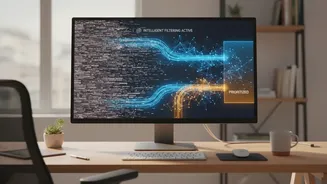
This is where smart AI email filtering comes in. Unlike their rules-based predecessors, AI tools use machine learning and natural language processing to understand the content and context of each message. An AI email agent doesn't just see who an email is from; it analyzes the language to determine its intent and urgency. These systems can intelligently triage an inbox by automatically categorizing messages into logical groups like 'Urgent,' 'Follow-up,' 'Newsletter,' or 'Receipts.' By observing a user's behavior—which emails they open immediately, which they snooze, and which they delete—the AI learns and adapts, becoming a personalized assistant that gets smarter over time.
Reclaiming Focus and Work-Life Separation
The primary benefit for remote professionals is the restoration of boundaries. By automatically sorting personal 'life admin' from professional tasks, AI allows workers to create distinct mental spaces. Instead of being constantly pulled away by non-work-related pings, they can dedicate focused blocks of time to their projects, knowing that anything truly urgent will be flagged for their attention. This reduces the cognitive load from context switching and creates an environment conducive to deep thinking. It allows professionals to batch-process their personal tasks—like paying bills or confirming appointments—during a designated break, rather than letting them chip away at the workday. The result is not just a cleaner inbox, but a more structured and less stressful workday.
The Future of Inbox Management
The technology is evolving rapidly. Many leading email platforms, from Google's Gmail to Microsoft Outlook, are integrating increasingly sophisticated AI features. Beyond simple categorization, modern AI assistants can now summarize long email threads, draft replies, and even extract action items with deadlines. Some advanced tools can identify a question in an email and automatically pull up a relevant document from your files or suggest a meeting time that works for everyone involved. For remote professionals juggling multiple roles at once, these tools are no longer a luxury; they are becoming essential infrastructure for maintaining productivity and well-being in a digital-first world.