







A Rotorcraft for a Distant Moon
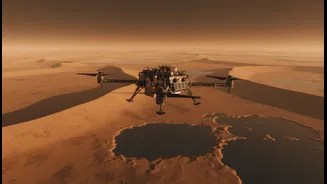
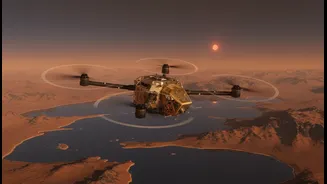
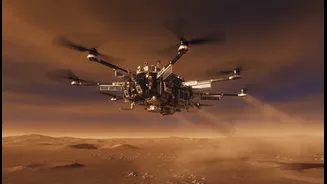
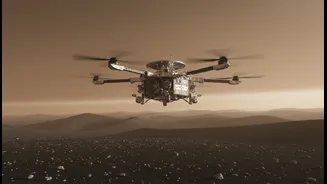
Dragonfly is not just another rover. It's a car-sized, nuclear-powered, dual-quadcopter—essentially an eight-rotor drone—designed to fly through the skies of Titan. Scheduled to launch in 2028 and arrive in 2034, its mission is to perform as a relocatable
lander. Unlike Mars rovers that slowly crawl across the surface, Dragonfly will be able to fly dozens of miles in a single trip, hopping between scientifically interesting locations to sample and analyze the environment. This leap in mobility is what makes the mission so revolutionary. It will cover more ground in its few years of operation than all previous Mars rovers combined, fundamentally changing how we explore alien surfaces.
Why Titan? A Prebiotic Chemical Laboratory
The destination is as important as the vehicle. Titan is a bizarre and captivating world, considered by scientists to be an analogue for early Earth. It's the only moon in our solar system with a dense atmosphere, which is about four times denser than Earth's, and it has a weather system with clouds, rain, rivers, and lakes—but they are all made of liquid methane and ethane, not water. The surface is covered in complex organic chemicals that rain down from the nitrogen-rich atmosphere. Scientists believe this environment could host prebiotic chemical processes, the steps that might lead to life. Dragonfly will investigate how far this chemistry has progressed, looking for the building blocks of life.
From Tech Demo to Science Powerhouse
While Ingenuity was a historic achievement, it was primarily a technology demonstration. Weighing just 1.8 kg, its purpose was to prove that flight was possible in Mars's thin atmosphere. Dragonfly is a full-fledged, SUV-sized science laboratory weighing around 450 kg. Its ability to fly is not just a demo; it's essential to its core mission. The thick atmosphere and low gravity on Titan actually make flight much easier than on Mars, allowing for a heavy, instrument-laden craft. Dragonfly will carry a suite of advanced tools, including drills to sample the surface and a mass spectrometer to analyze the composition of materials, searching for biosignatures.
Science on the Fly
The mission's science goals are ambitious. Dragonfly will land initially in the equatorial 'Shangri-La' dune fields, which are compositionally similar to dunes in Namibia. From there, it will embark on a series of flights, with a primary goal of reaching the Selk impact crater. Scientists theorize that the energy from the impact that created the crater could have melted the local water ice, creating a temporary pool of liquid water that mixed with Titan's abundant organic compounds. By sampling these diverse locations, Dragonfly will characterize Titan's habitability, search for chemical signs of past or present life, and help us understand the origins of life on our own planet.
The Future of Exploration is Airborne
Dragonfly represents a paradigm shift in planetary science. For decades, our view of other worlds has been limited to what stationary landers can see or how far rovers can slowly travel. Aerial mobility opens up vast, previously inaccessible regions. Success on Titan could pave the way for future aerial missions to other destinations with atmospheres. Imagine helicopters or blimps exploring the thick, cloudy skies of Venus or drones navigating the canyons of Mars with greater speed and efficiency. Missions like Dragonfly are not just about exploring one moon; they are about developing the technology and strategies that will allow us to explore entire worlds, not just landing sites.