








The Tyranny of the Fuel Tank
For any satellite, the most valuable real estate is the space taken up by its payload—the cameras, sensors, and antennas that perform its mission. But a huge portion of any satellite's mass is dedicated to fuel. This is especially true for those operating
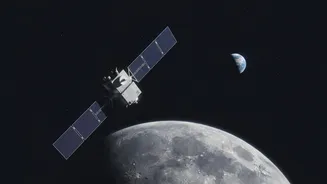
in Very Low Earth Orbit (VLEO), an altitude below 450 kilometers. Down there, the benefits are enormous: Earth observation satellites can capture much higher-resolution images, and communication satellites can offer lower latency. The problem is that even at this altitude, there's a thin atmosphere that creates persistent drag, slowing the spacecraft down. To stay in orbit, satellites must constantly fire their thrusters, and every firing sips precious, finite propellant. Once the tank runs dry, the mission is over, and the satellite spirals back to Earth. This fundamental limit has made long-duration missions in VLEO economically and logistically challenging.
A 'Jet Engine' for the Edge of Space
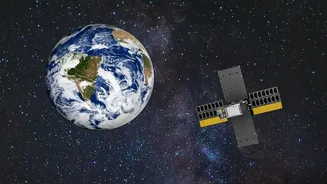
Air-Breathing Electric Propulsion (ABEP) offers a radical and elegant solution: turn the problem into the propellant. Instead of carrying heavy tanks of fuel like xenon, an ABEP system uses a specially designed intake to scoop up the residual atmospheric molecules it encounters as it speeds through orbit. Once collected, these molecules—mostly atomic oxygen and nitrogen—are funneled into an electric thruster. Powered by the satellite’s solar panels, the thruster uses electric and magnetic fields to ionize the captured particles (give them an electric charge) and then accelerate them out the back at high speed. This expulsion creates thrust, counteracting the atmospheric drag. The result is a system that, in theory, can operate as long as its solar panels generate power, enabling missions that could last for years, not months.
From Theory to Tangible Tech
This isn't just a science-fiction concept. The European Space Agency (ESA) has been a pioneer in this field, successfully test-firing a prototype in a vacuum chamber that simulated the conditions at a 200km altitude. During the test, engineers saw the engine's tell-tale plume change from the blue of its starter xenon gas to the purple of ionized air, proving the concept was viable. Since those initial tests, multiple projects across Europe have advanced the technology, focusing on improving the efficiency of the air intakes and developing new types of thrusters that can operate without cathodes, a component that can wear out over time. As recently as March 2026, a project backed by the ESA passed a major design review, confirming the technical maturity of a cathodeless thruster designed for VLEO satellites. This moves the technology from a working concept to something ready for hardware development and integration.
The Dawn of 'Perpetual' Orbits
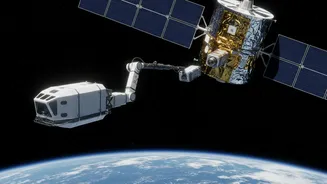
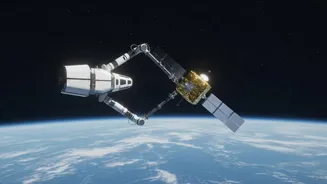
The implications for the space industry are profound. Free from the constraints of onboard fuel, satellites could operate in VLEO for extended periods, opening up new business models for Earth observation and global communications. Constellations of air-breathing satellites could provide persistent, high-resolution monitoring for everything from agriculture to disaster response. The technology could also play a role in space sustainability. An ABEP-equipped vehicle could potentially act as a space tug, maneuvering to de-orbit space debris without expending its own limited fuel supply. While significant engineering challenges remain, such as optimizing the intake design to collect enough particles without creating excess drag, the path forward is becoming clear. There is even an Ahmedabad-based startup, Orbitt Space, developing its own VLEO platform using this technology, showing a growing global interest. This innovation promises to unlock the full potential of low-altitude orbits, making them more accessible, sustainable, and commercially viable than ever before.