







The Sneaky Toll of Sitting
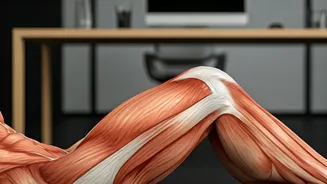
Our bodies are not designed for the 8-hour marathon of sitting that defines modern office life. When you're hunched over a keyboard, your core muscles—the deep abdominal and back muscles that form a supportive corset around your spine—go dormant. This
leads to a cascade of problems: your posture slumps, your lower back aches, your hip flexors tighten, and your metabolism slows down. The result isn't just physical discomfort; it’s a profound sense of fatigue that coffee can't fix. This sedentary drain saps your focus and productivity, making the workday feel longer and more exhausting than it should be.
Why the Plank Is Your Secret Weapon
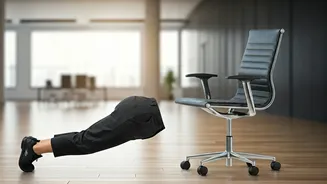
Enter the plank. This seemingly simple exercise is a powerhouse for anyone stuck at a desk. Unlike crunches that target only the front abdominals, the plank is an isometric exercise that engages your entire core: the transverse abdominis, rectus abdominis, obliques, and even your glutes, back, and shoulders. By strengthening these muscles, you build a stronger support system for your spine. This improved stability directly combats the slouching that causes back pain and fatigue. Best of all, it requires zero equipment, minimal space, and can be done in just a few minutes a day, making it the perfect antidote to workplace weariness.
How to Master the Perfect Form
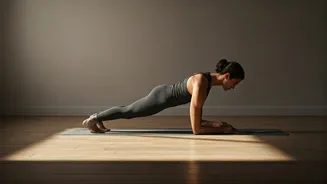
Before you begin, nailing the form is crucial to prevent injury and get the most out of the exercise. We'll focus on the forearm plank, which is friendlier on the wrists. 1. **Get into position:** Lie face down on the floor or a mat. Place your forearms on the floor with your elbows directly under your shoulders and your hands clasped or flat on the floor. 2. **Lift your body:** Push off the floor, raising your hips until your body forms a straight line from your head to your heels. Your feet should be hip-width apart. 3. **Engage your core:** Brace your abdominal muscles as if you're about to be punched in the stomach. Squeeze your glutes to stabilise your lower back. 4. **Maintain the line:** Do not let your hips sag or rise too high. Your back should be flat, not arched. Keep your gaze down at the floor to maintain a neutral neck position. 5. **Breathe:** Remember to breathe steadily throughout the hold. Holding your breath will only make it harder.
The 10-Day Plank Challenge: Your Plan
The goal is consistency, not perfection. If you can't hold for the full time, just do your best and try again tomorrow. You can split the total time into smaller sets if needed (e.g., two 15-second holds instead of one 30-second hold). * **Day 1: 20 seconds.** Your starting line. Focus entirely on perfect form. * **Day 2: 30 seconds.** You’ll feel the challenge, but it's manageable. Breathe through it. * **Day 3: 40 seconds.** The burn is real! Keep your core tight and your back straight. * **Day 4: 45 seconds.** Push past the mental barrier. You're building endurance. * **Day 5: 60 seconds.** Congratulations, you’ve hit the one-minute mark! This is a major milestone.
The Challenge: Days 6 to 10
You've built a solid foundation. Now it's time to solidify your gains and push your limits just a little further. * **Day 6: 60 seconds.** Repeat your Day 5 success to build confidence and consistency. * **Day 7: 75 seconds (1 minute, 15 seconds).** Break it into a 60-second hold and a 15-second hold if you need to. * **Day 8: 90 seconds (1 minute, 30 seconds).** Your core is getting significantly stronger. Focus on keeping your hips level. * **Day 9: 105 seconds (1 minute, 45 seconds).** You are so close to the finish line. Don't let your form falter now. * **Day 10: 120 seconds (2 minutes).** You did it! Holding a two-minute plank is a fantastic achievement that proves your progress.