






A Journey to the Sun's Interior
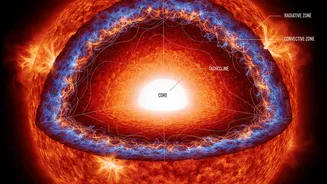
Before we can appreciate the mystery, we need a quick tour of the Sun's internal structure. At its heart is the core, a super-dense and incredibly hot region where nuclear fusion generates all the Sun's energy. This energy then travels outward through
the vast radiative zone, a process that can take hundreds of thousands of years as photons bounce from particle to particle. The final layer of the interior is the convection zone, which makes up the outer 30% of the Sun. Here, hot plasma physically rises, cools, and sinks, much like a boiling pot of water, carrying energy to the surface. It's between these last two layers that our mystery resides.
Meet the Tachocline
The tachocline is the transition region separating the calm, orderly radiative zone from the turbulent, churning convection zone. The name, coined in 1992, is an analogy to the ocean's thermocline, which separates different temperature layers. In the Sun, the tachocline separates two different styles of rotation. The deep radiative interior rotates like a solid object, a single rigid ball. In contrast, the gaseous convection zone above it spins differentially, meaning the equator rotates much faster than the poles. The tachocline is the incredibly thin shear layer where these two dramatically different motions meet. It’s a place of immense physical stress and strain.
The Riddle of Its Thinness
Here lies the central puzzle that has challenged solar models for decades. Logically, the turbulent motions of the massive convection zone should dredge deep into the stable radiative zone below, mixing the two and creating a very broad, blurry transition. Over the Sun's 4.6-billion-year lifespan, this mixing should have resulted in a thick, gradual boundary. Yet, observations from helioseismology—the study of solar vibrations—show the tachocline is astonishingly sharp and thin, less than 5% of the Sun's radius. Something powerful must be holding back the convection zone, preventing it from eroding the radiative zone and maintaining this impossibly crisp dividing line. This discrepancy is a major headache for astrophysicists because it means their standard models of stellar interiors are missing a key ingredient.
The Engine of the Solar Dynamo
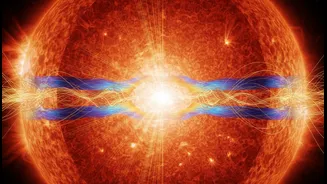
The tachocline’s importance extends far beyond being a simple boundary. It is widely believed to be the primary location of the solar dynamo—the physical process that generates the Sun's massive and complex magnetic field. The immense shear forces in the tachocline, where the fast-differentiated rotation grinds against the slow, solid rotation, stretch and amplify magnetic field lines. This process transforms weaker poloidal fields (running from pole to pole) into powerful toroidal fields (which wrap around the Sun's latitude). These amplified magnetic fields eventually become unstable and buoyant, rising through the convection zone to erupt on the surface as sunspots, solar flares, and coronal mass ejections.
Why Solving the Puzzle Matters
Understanding why the tachocline is so thin is crucial for several reasons. Since it is the engine of the solar dynamo, a complete model of the tachocline would unlock the secrets of the 11-year solar cycle. This would dramatically improve our ability to predict space weather. Powerful solar flares and coronal mass ejections can damage satellites, disrupt power grids on Earth, and pose a risk to astronauts. Better forecasting gives us more time to prepare and protect our critical infrastructure. Furthermore, because the tachocline is a fundamental feature in stars above a certain mass, solving this solar puzzle would provide profound insights into the magnetic activity and evolution of countless other stars throughout the galaxy.