


The Global Coastal Carbon Vault
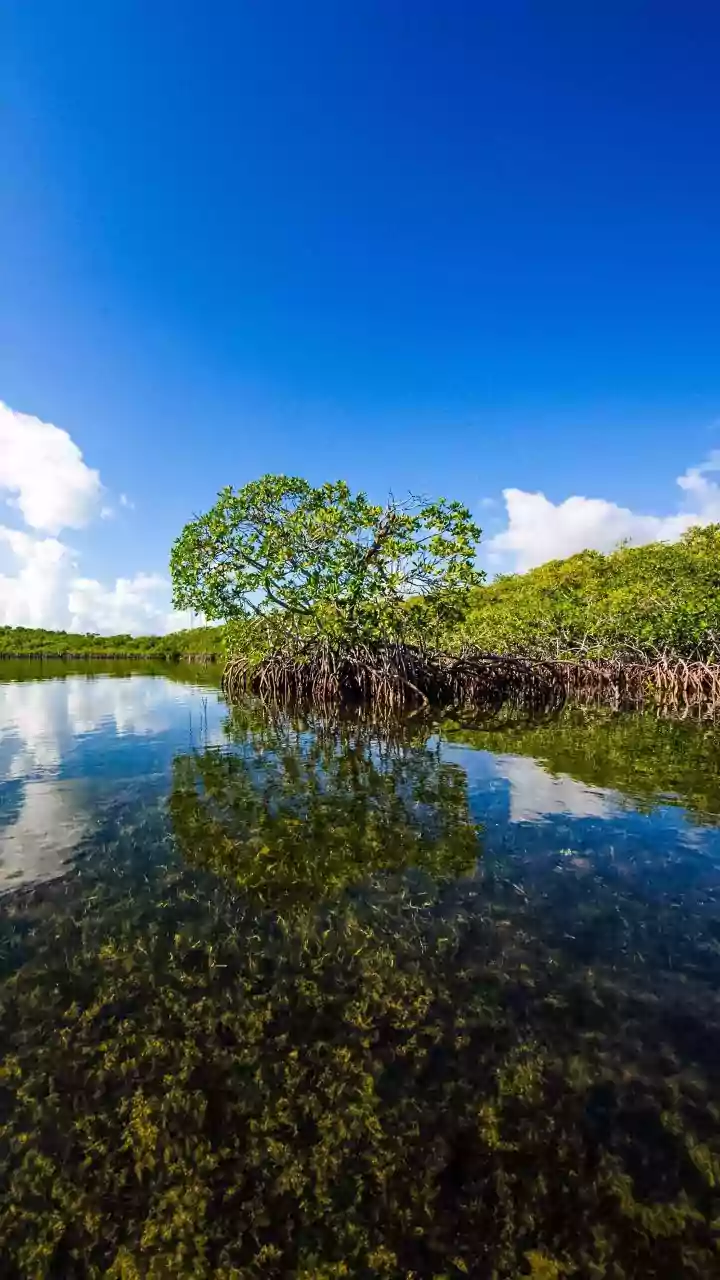
Coastal ecosystems like mangroves, salt marshes, and seagrass meadows are powerhouses of carbon storage. Known collectively as “blue carbon” ecosystems, they pull enormous quantities of carbon dioxide from the atmosphere and lock it away in their soil
and vegetation. These environments are incredibly efficient, sequestering carbon at a rate up to ten times greater than mature tropical forests and storing three to five times more carbon per acre. The waterlogged, low-oxygen soils prevent decomposition, meaning the carbon can remain stored for centuries or even millennia. The Arctic permafrost region is another massive carbon reservoir, holding an estimated 1,300 to 1,600 billion metric tons of organic carbon in its frozen soils—roughly double the amount currently in the atmosphere.
An Old Assumption Washed Away
For a long time, the scientific consensus was fairly straightforward: when these coastlines erode, the stored carbon is exposed to oxygen, consumed by microbes, and released back into the atmosphere as carbon dioxide, further accelerating climate change. This process, known as microbial decomposition, turns a long-term carbon sink into an immediate carbon source. The logic seemed sound, and it painted a grim picture of a powerful feedback loop where warming causes erosion, which in turn releases more carbon and causes more warming. The destruction of these habitats, which are being lost at an alarming rate due to development and climate impacts, was thought to release up to a billion metric tons of carbon dioxide annually.
A More Complex Picture Emerges
However, recent studies are revealing a much more nuanced story. It turns out that a significant portion of the eroded carbon doesn't instantly return to the atmosphere. Instead, much of it is washed into the ocean and buried in seafloor sediments. A recent study focusing on the Arctic coast found that marine microbes, the tiny organisms responsible for breaking down organic matter, are surprisingly picky eaters. They much prefer to consume fresher, marine-based carbon sources, like dead algae, than the ancient, land-based carbon from eroded permafrost. As a result, the majority of this old, terrestrial carbon settles on the seafloor and remains buried, effectively staying locked away from the atmosphere.
The Arctic Is a Special Case
The findings are particularly critical in the rapidly warming Arctic. Coastlines there, made of ice-rich permafrost, are crumbling away fast, releasing huge amounts of organic material that has been frozen for thousands of years. Projections show this outflow of carbon into the Arctic Ocean could increase by 70 to 150 percent by the year 2100. While new research from Canada's Herschel Island suggests that only about 10% of this permafrost carbon is converted into greenhouse gases by seabed microbes, scientists caution this isn't necessarily good news. The sheer volume of eroding material means that even a small percentage translates to a significant amount of new emissions. Furthermore, some carbon may be broken down in the water column before it even reaches the seabed, a process scientists are still working to quantify.
Why This Changes Everything for Climate Models
This evolving understanding has major implications for the climate models used to predict our future. Accurately tracking the planet's carbon budget—where it's stored and where it's being released—is essential for forecasting warming scenarios. If a large fraction of eroded coastal carbon is being re-buried in the ocean rather than entering the atmosphere, it represents a crucial natural mechanism for long-term carbon sequestration that many models have been missing. While this re-burial is a positive factor, it doesn't cancel out the threat. The erosion itself still has other negative impacts, such as making coastal waters cloudier, which can harm the marine algae that form the base of the food web. Understanding the complete journey of this carbon is vital for refining our predictions and shaping effective climate policy.