



The Sun's Hidden Engine Room
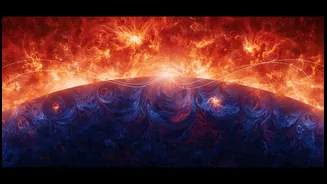
To understand our Sun, you have to look beneath its fiery surface. The interior is structured in layers: a core where nuclear fusion rages, a vast radiative zone where energy slowly travels outward, and an outer convection zone where hot plasma boils
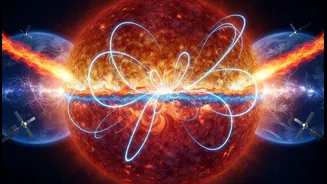
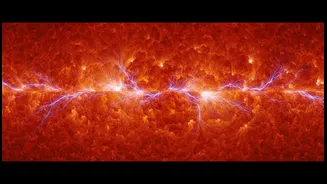
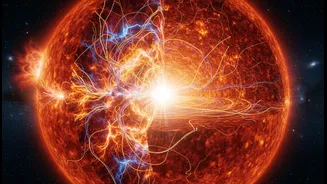
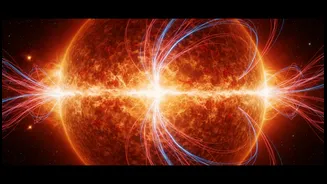
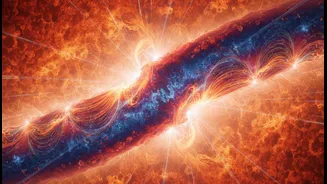
like water in a pot. Between the stable radiative zone and the chaotic convection zone lies a remarkably thin, turbulent boundary layer called the tachocline. Situated about 200,000 kilometres below the surface, this layer has long been a source of mystery. Scientists have theorised since its discovery in 1992 that the tachocline acts as the engine room for the Sun's magnetic field, a process known as the solar dynamo. It’s a region of immense shear, where the rigid rotation of the deep interior clashes with the differential rotation of the outer layers, creating the perfect conditions to generate and amplify powerful magnetic fields.
Listening to the Heartbeat of a Star
Peering into the Sun's interior is not easy, but scientists have a clever method called helioseismology. Much like how geologists use seismic waves from earthquakes to map Earth's interior, solar physicists study sound waves that constantly ripple through the Sun. These oscillations, observed as subtle doppler shifts on the solar surface, carry information about the structure, density, and flow of the plasma they travel through. By tracking these waves with instruments on observatories like the Solar and Heliospheric Observatory (SOHO) and the Solar Dynamics Observatory (SDO), scientists can build a detailed map of the Sun's hidden depths. This solar 'ultrasound' is what allows them to detect large-scale flow patterns deep beneath the surface, patterns that hold the key to understanding the star's behaviour.
A Breakthrough Connection
For years, the link between the tachocline and surface activity was purely theoretical. The big question was whether the magnetic fields generated there could directly cause the sunspots and solar flares we see. Recent studies have provided the first strong observational proof. By analysing nearly three decades of helioseismology data, researchers have identified patterns of flowing plasma called 'torsional oscillations'—bands of faster and slower rotation—that originate near the tachocline. They found that these bands slowly migrate upward through the convection zone over several years. The crucial discovery is that the emergence of these flow patterns at the surface directly corresponds with the location and timing of sunspot formation, the dark patches that mark intense magnetic activity.
Solving the Solar Cycle Mystery
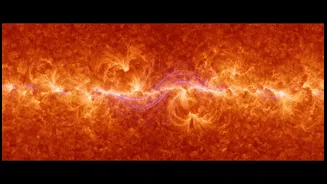
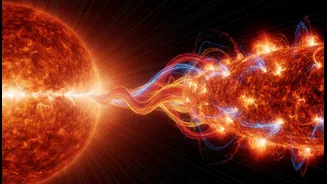
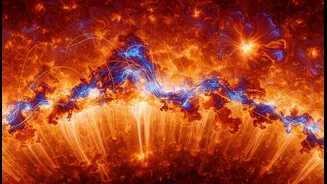
This discovery provides a physical explanation for the Sun's famous 11-year solar cycle, during which sunspot activity waxes and wanes. The new evidence shows a butterfly-shaped pattern of magnetic activity that begins deep within the tachocline and is mirrored years later by the sunspot 'butterfly diagram' on the surface. This strongly supports the idea that the tachocline is indeed the deep-seated origin of the solar dynamo. It essentially confirms that the twisting and tangling of magnetic field lines in this deep shear layer is what fuels the entire cycle. These tangled fields become buoyant, rise through the convection zone, and eventually burst through the photosphere as sunspot pairs, driving solar flares and other activity.
Why This Matters for India and the World
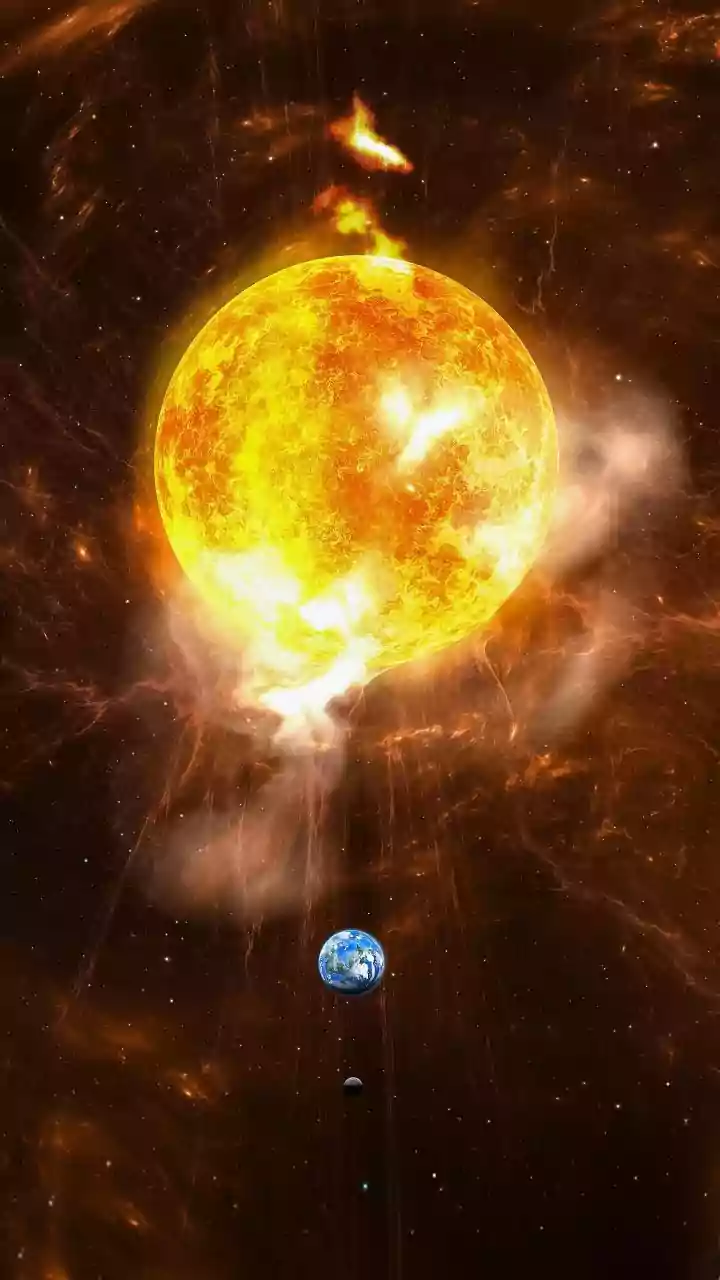
This breakthrough is more than just an academic victory; it has profound practical implications. The violent storms on the Sun, such as coronal mass ejections (CMEs), can have serious consequences on Earth. They can disrupt and damage satellites, which are crucial for ISRO's space missions, our communication networks, and GPS navigation. Severe space weather can also endanger astronauts and even cause widespread blackouts by overloading power grids. Until now, our ability to forecast these events has been limited to a few days at best. By being able to see the 'seeds' of solar activity forming deep inside the Sun, this new understanding of the tachocline's role could potentially extend our space weather forecasting window to months or even years, allowing for far better preparation and protection of our critical infrastructure.