



An Orbital Junkyard
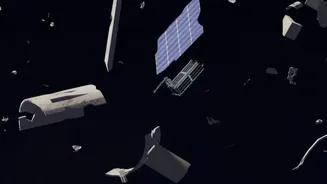
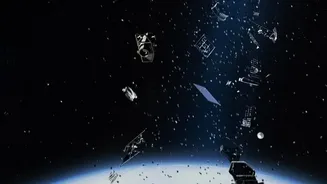
Since the space race began, humanity has launched thousands of rockets and satellites. While many are still operational, a vast number are now defunct, aimlessly orbiting our planet. These are joined by spent rocket stages, fragments from accidental collisions,
and even items as small as paint flecks. As of 2026, surveillance networks are tracking over 29,000 objects larger than 10cm, but there are an estimated 1.2 million pieces between 1cm and 10cm, and over 140 million fragments smaller than that. Travelling at speeds of over 28,000 km/h, even a tiny object carries enough energy to disable a critical satellite or endanger crewed spacecraft. Experts warn of the Kessler Syndrome, a theoretical cascade where one collision creates more debris, leading to a chain reaction that could render parts of Earth's orbit unusable.
Going Fishing with Harpoons and Lasers
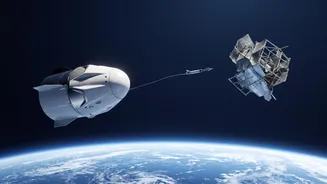
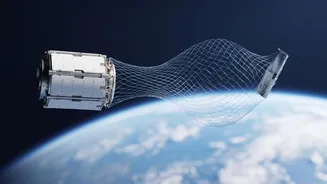
One of the most direct approaches to capturing large debris is the harpoon. Several agencies and companies have developed and tested concepts for a chaser satellite to fire a harpoon into a target, like a defunct satellite or rocket body. Once tethered, the chaser can then pull the debris into a lower orbit where it will burn up in the atmosphere. The simplicity and speed of a harpoon makes it effective for capturing targets that may be tumbling uncontrollably. A more futuristic concept is the 'laser broom' or laser harpoon. This involves a ground-based or space-based laser firing a pulse of energy at a piece of debris. This doesn't vaporize the object, but instead heats a small part of its surface, creating a plume of plasma that acts like a tiny thruster, nudging the object into a new, decaying orbit. This method is seen as particularly promising for dealing with the millions of smaller, untrackable but still dangerous fragments.
The Pull of Magnetic Solutions
Another innovative solution involves magnets. Japanese company Astroscale has been a pioneer in this area. Their ELSA-d mission successfully demonstrated a magnetic capture mechanism in 2021. The concept relies on future satellites being launched with a standardized magnetic docking plate. When a satellite reaches the end of its life, a 'servicer' spacecraft can approach, lock on to the plate, and then safely tow the satellite out of orbit. Astroscale's upcoming ELSA-M mission, planned for 2026, aims to be the first commercial demonstration of this service by removing a full-sized satellite from orbit. While this requires new satellites to be prepared for capture, other concepts explore using powerful electromagnets to influence and move non-magnetic but conductive debris (like objects made of aluminum) using induced eddy currents, a non-contact way to grab junk.
The Pioneers of Orbital Cleanup
A new commercial industry is emerging to tackle the debris problem. Alongside Astroscale, Swiss startup ClearSpace was commissioned by the European Space Agency (ESA) for its own debris removal mission. The ClearSpace-1 mission, scheduled for launch around 2028, will use a four-armed 'space claw' to capture and de-orbit a piece of a European rocket. The mission highlights a shift from merely mitigating new debris to actively removing what's already there. These commercial efforts are supported by government agencies like ESA, the UK Space Agency, and JAXA in Japan, who are funding and partnering on these pioneering missions. This growing market, expected to be worth hundreds of millions of dollars, is turning a global problem into a business opportunity focused on space sustainability.