




What Are These Ripples in Reality?
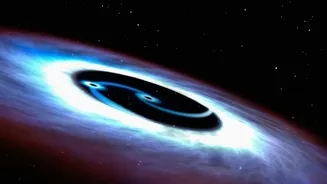
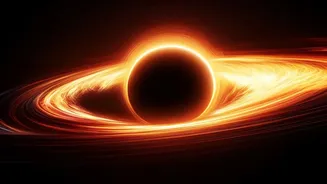
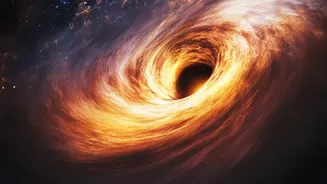
Imagine the universe not as an empty void, but as a stretched-out fabric, a cosmic trampoline called spacetime. Now, imagine two incredibly heavy objects, like black holes, spinning around each other and finally crashing together. This cataclysmic event
doesn't just happen quietly; it sends out waves across the fabric of spacetime, much like dropping a stone in a still pond creates ripples. These are gravitational waves. First predicted by Albert Einstein over a century ago, they are literal distortions of reality, stretching and squeezing space itself as they travel across the cosmos at the speed of light. For most of history, they were purely theoretical. But now, thanks to hyper-sensitive observatories, we can 'hear' these echoes from the universe's most violent events.
The Universe's Elusive 'Middle Child'
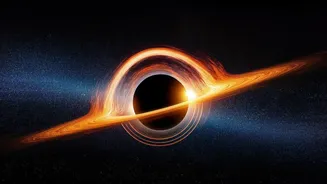
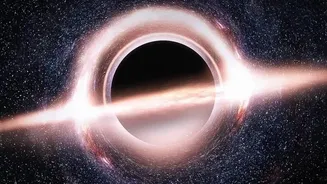
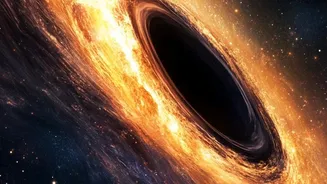
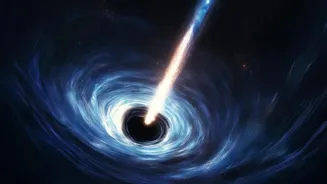
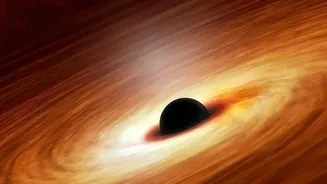
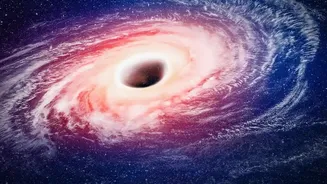
When it comes to black holes, astronomers have plenty of evidence for the small and the super-large. There are 'stellar-mass' black holes, which are maybe 5 to 100 times the mass of our sun, formed from the collapse of giant stars. Then there are the 'supermassive' black holes that lurk at the heart of nearly every galaxy, including our own Milky Way, weighing millions or even billions of times more than the sun. But for decades, there has been a frustrating gap in between: the intermediate-mass black holes (IMBHs). Scientists were sure they had to exist, but finding them proved incredibly difficult. This new discovery is so exciting because it has captured the gravitational wave signature of two IMBHs merging, providing some of the clearest evidence yet that this 'missing link' population is real.
How the Discovery Was Made
Detecting these spacetime ripples is an astonishing feat of engineering. The discovery was made by the LIGO-Virgo-KAGRA (LVK) collaboration, a global network of gravitational-wave observatories in the United States, Italy, and Japan. These are not traditional telescopes. Instead, they are giant L-shaped instruments with arms stretching several kilometres long. Lasers are beamed down these arms and reflected back. When a gravitational wave passes through Earth, it minutely stretches one arm while squeezing the other. The change is unfathomably small—less than one-thousandth the diameter of a proton—but the detectors are sensitive enough to pick it up. By combining data from multiple locations, scientists can triangulate the source of the cosmic collision in the sky.
Why This Merger Is a Game-Changer
Finding two IMBHs in the act of merging is more than just a cosmic novelty; it helps answer a fundamental question about the universe. How do supermassive black holes get so big? One leading theory is called 'hierarchical merging': smaller black holes merge to form bigger ones, and those bigger ones merge again, and so on, building up to colossal sizes over billions of years. This detection of a mid-sized merger provides a crucial, real-world snapshot of that process in action. It’s like finding a fossil of a teenager dinosaur after only ever finding babies and giant adults. It fills in a vital part of the evolutionary story, suggesting that the giants we see at the centre of galaxies today may have grown from a series of smaller collisions just like this one.
India's Role in Listening to the Cosmos
This new frontier of astronomy has a significant Indian connection. A new observatory, LIGO-India, is currently under construction in the Hingoli district of Maharashtra and is poised to join the global network. This is a collaborative project between Indian research institutions and the LIGO Laboratory in the US. The addition of LIGO-India will be transformative. Having a fourth major detector so far from the others will dramatically improve the network's ability to pinpoint the exact location of these cosmic events in the sky. This enhanced precision will allow astronomers using traditional telescopes to quickly look at the right spot to see if there's any light, like a flash from a neutron star collision, associated with the gravitational waves. This places India at the very heart of the future of multi-messenger astronomy, a field that combines different signals to create a richer picture of the universe.