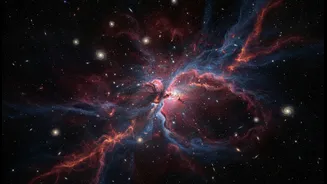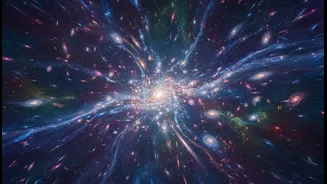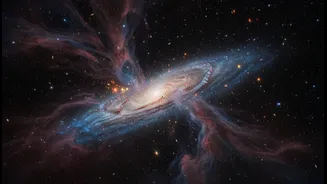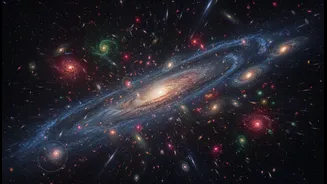



A New Cosmic Masterpiece
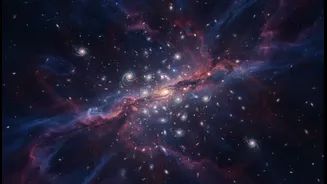
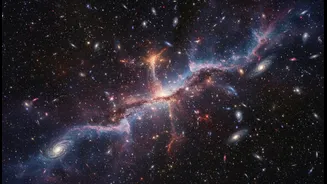
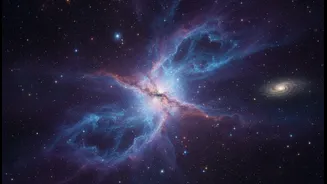
The new dispatch comes from a region of space known as Pandora's Cluster, or Abell 2744. It's a place where at least three massive galaxy clusters are slowly crashing into each other, creating a cosmic megacluster. Previous images from the Hubble Space
Telescope showed us the core of this region, but Webb’s powerful infrared instruments have now revealed the full panorama in breathtaking detail. The image is a dizzying tapestry of light, containing an estimated 50,000 near-infrared light sources. While some bright, spiky objects are stars in our own Milky Way, almost every other point of light in the frame is an entire galaxy, each containing billions of stars of its own.
More Than Just A Pretty Picture
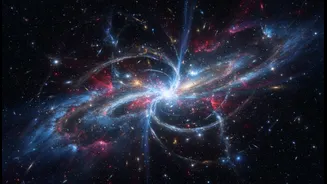
The real magic of this image lies in a phenomenon first predicted by Albert Einstein: gravitational lensing. The immense combined mass of the galaxies in Pandora's Cluster is so great that it literally bends the fabric of spacetime around it. This warped space acts like a natural magnifying glass, a 'cosmic lens' for the telescope. It takes the faint light from even more distant galaxies sitting far behind the cluster, and both magnifies and distorts it into shimmering arcs and streaks of light. Thanks to this effect, Webb can see objects that would otherwise be far too faint and distant to detect. It’s like using a mountain to see a pebble on the other side.
Outshining Its Predecessor
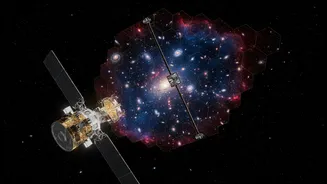
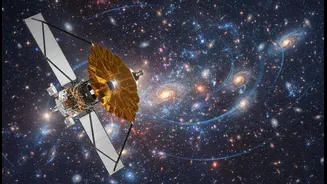
For decades, the Hubble Space Telescope was our primary eye on the universe, and it studied Pandora's Cluster as well. But Hubble, which sees primarily in visible and ultraviolet light, couldn't penetrate the thick cosmic dust and gas to the same extent as Webb, which is optimized for infrared light. This latest view from Webb has revealed hundreds of newly discovered lensed galaxies that were completely invisible to Hubble. The level of detail is so profound that astronomers feel they are seeing this region for the first time. The new data provides a much deeper, clearer, and more expansive view, opening up a new frontier in the study of cosmology.
Rewriting the Early Universe
This powerful new view is already challenging long-held theories about the early universe. By studying the magnified light of the most distant galaxies in the image, astronomers are getting their best look yet at the 'cosmic dawn'—the period just a few hundred million years after the Big Bang. Recent Webb observations of other clusters have found galaxies that appear more massive and structured than theories predicted should exist so early in cosmic history. These 'impossible' early galaxies suggest that the process of galaxy formation may have been much faster and more efficient than our models accounted for. Pandora's Cluster, with its treasure trove of lensed background objects, provides a massive new dataset to either confirm these surprising findings or add new, complex twists to the story of how the first stars and galaxies came to be.
What Happens Next?
For astronomers, the image is not an endpoint, but a starting point. It's a map that points the way to future discoveries. The team behind the UNCOVER program, which captured the image, is now sifting through the 50,000 light sources to identify the most promising targets for follow-up studies. Using Webb's spectroscopic instruments, they can analyze the light from individual distant galaxies to determine their age, chemical composition, and distance with incredible precision. This will help solve mysteries like the nature of the earliest galaxies and how the supermassive black holes at their centers grow. Each arc of light is a clue, a message from the past that we are only now equipped to read.