





A Journey to the Center of the Sun
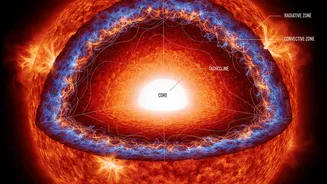
To understand the Sun's explosive behavior, we first have to appreciate its structure. It’s not a solid ball of fire but a series of layers, each with its own role. At the heart is the core, a thermonuclear furnace where energy is born. This energy then
travels outward through the vast radiative zone. Above that is the convection zone, a region of boiling, roiling plasma that carries heat to the surface. For a long time, scientists understood these broad zones, but the most critical action, it turns out, happens at the boundary between them.
Meet the Tachocline
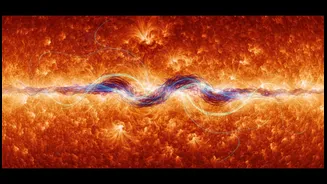
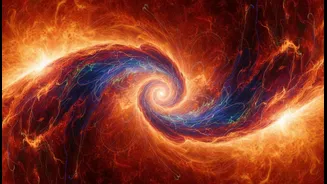
This crucial boundary is called the tachocline. It’s a remarkably thin layer, making up less than 4% of the Sun's radius, separating the rigidly rotating inner radiative zone from the turbulent, differentially rotating outer convection zone. Think of it like a bearing between two parts of an engine moving at different speeds. In the convection zone, the Sun’s equator spins faster than its poles. Below, in the radiative zone, everything spins together like a solid object. The tachocline is the shear layer where these two distinct motions meet, creating immense physical stress.
The Engine of Solar Magnetism
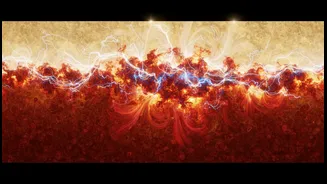
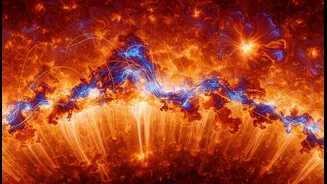
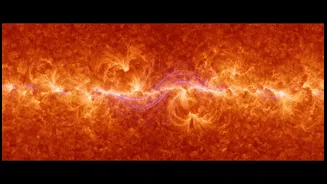
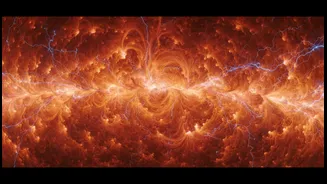
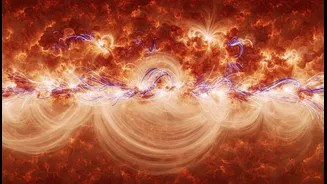
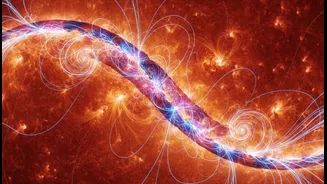
This intense shear is what makes the tachocline the heart of the solar dynamo—the process that generates the Sun's massive magnetic field. The conflicting motions twist and amplify magnetic field lines, like winding a rubber band tighter and tighter. This process stores incredible amounts of energy. Recent research and advanced computer models suggest the tachocline acts as a magnetic factory and storage facility, building up powerful, rope-like magnetic structures. The mystery for a long time was why this layer remained so thin and didn't just blur out over billions of years. Newer models show that fluctuating magnetic fields within the layer itself may act as a containment mechanism, keeping it sharp and defined.
From Deep Storage to Violent Eruption
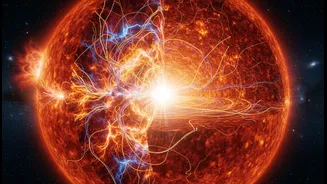
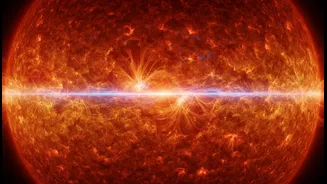
The energy stored in the tachocline doesn't stay there forever. When these tightly wound magnetic field ropes become too stressed or buoyant, they rise through the 200,000-kilometer-thick convection zone. They eventually burst through the Sun's visible surface, the photosphere, creating sunspots. These sunspots are the visible markers of intense magnetic activity deep below. When these complex magnetic fields at the surface realign, short-circuit, or snap, the stored energy is catastrophically released in the form of solar flares (intense bursts of radiation) and coronal mass ejections (CMEs), which are massive clouds of magnetised plasma hurled into space.
Why This Matters on Earth
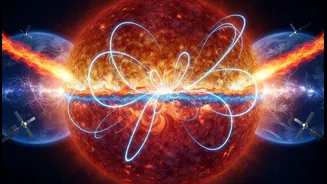
While the tachocline is a deep, internal feature of the Sun, its influence is felt across the solar system, including here on Earth. The solar eruptions it orchestrates are the drivers of space weather. When a powerful CME is aimed at our planet, it can have serious consequences for our technology-dependent society. These storms can disrupt radio communications, damage the electronics on satellites essential for GPS and weather forecasting, and even induce currents in power grids that can lead to widespread blackouts. Understanding the tachocline is therefore not just an astronomical curiosity; it’s a crucial part of improving our ability to forecast space weather and protect the vital infrastructure we all rely on.