







Why Weak Ankles Are a Problem
Weak ankles are more than just a minor inconvenience; they can be a precursor to a host of problems. The ankle joint is a complex structure responsible for bearing your body weight, absorbing shock, and enabling movement. When the muscles and ligaments
supporting it are weak, your risk of painful sprains and strains increases dramatically. Even a simple misstep on an uneven pavement can lead to a significant injury. Furthermore, unstable ankles can affect your entire kinetic chain, potentially causing alignment issues in your knees, hips, and back. This instability can also lead to chronic conditions like tendonitis or plantar fasciitis, and negatively impact your balance and confidence during physical activities, from walking up stairs to playing a sport.
The Desk Job Connection
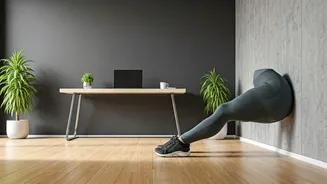
Long hours spent sitting at a desk are a primary contributor to ankle weakness. When you're seated, your calf muscles—the gastrocnemius and soleus—and the smaller stabilising muscles around the ankle joint remain inactive. Over time, this lack of use leads to atrophy, where the muscles lose strength and tone. This condition, often termed 'disuse atrophy,' means the very structures designed to protect your ankle from rolling or twisting are not prepared to do their job when you suddenly need them. Think about standing up after hours of sitting or rushing to catch a bus; your ankles are suddenly called into action without being properly conditioned, making them highly vulnerable to injury.
How Calf Raises Build Ankle Strength
The single-leg calf raise is a powerhouse exercise for building lower leg and ankle stability. Its effectiveness lies in its ability to isolate and strengthen the key muscles that support the ankle. When you lift your heel, you engage the large calf muscles, which act as primary movers and shock absorbers. More importantly, the single-leg variation challenges your proprioception—your body's awareness of its position in space. Your body is forced to make constant, tiny adjustments to maintain balance, which fires up the smaller, intrinsic muscles surrounding the ankle joint. Strengthening these muscles creates a more stable, robust support system, making the ankle less likely to give way under stress.
Your Step-by-Step Guide
Performing this exercise correctly is crucial for getting results and avoiding strain. You can do this discreetly while on a phone call or reading an email. 1. Stand Up: Stand behind your chair or next to your desk, placing your fingertips lightly on the surface for balance. Do not lean on it for support. 2. Position Your Feet: Stand with your feet hip-width apart. Shift your weight onto one leg and lift the other foot off the ground, either by bending the knee or resting it lightly on the back of your standing ankle. 3. Lift Slowly: In a slow and controlled motion, press through the ball of your standing foot to raise your heel as high as you comfortably can. Focus on going straight up, not leaning forward or backward. 4. Hold and Lower: Hold the top position for a second, feeling the contraction in your calf muscle. Then, slowly lower your heel back to the floor, taking at least three to four seconds for the descent. The lowering phase is just as important as the lift. 5. Repeat: Aim for 10-15 repetitions on one side before switching to the other leg.
Frequency and Making Progress
Consistency is key. Aim to perform 2-3 sets of 10-15 reps on each leg, about three to four times a week. You can easily integrate this into your workday—perhaps once in the morning and once in the afternoon. Listen to your body. If you feel any sharp pain, stop immediately. You should feel a burn in your calf muscle, not a pinching sensation in the joint. As you get stronger, you can progress the exercise. Try to use less and less support from your desk, eventually working towards performing the raises with your hands on your hips. For an even greater challenge, you can perform them on the edge of a small, stable step to increase the range of motion, but only when you have mastered the flat-ground version.