




Look up. Soon, you might catch a glimpse of the world’s most powerful rocket. SpaceX’s colossal Starship is preparing for its next major test flight, and its orbital path is expected to take it directly over India multiple times.
Meet Starship: The Rocket of the Future
Before we talk about its
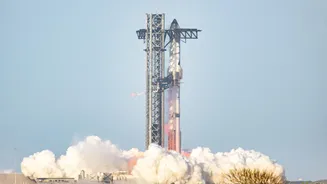
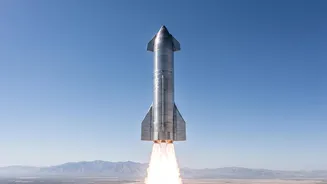
journey across our skies, what exactly is Starship? Developed by Elon Musk’s SpaceX, it is the tallest and most powerful launch vehicle ever built, standing at an impressive 121 metres high. For context, that’s taller than the Qutub Minar. It’s designed for complete and rapid reusability, a revolutionary concept that could drastically reduce the cost of accessing space. The system has two parts: a massive first-stage booster called Super Heavy and the upper-stage spacecraft, which is also named Starship. The ultimate goal for this vehicle is ambitious: to carry crew and cargo to Earth orbit, the Moon, and eventually Mars, making humanity a multi-planetary species.
Flight 15: An Ambitious New Mission
The upcoming mission, designated Starship Flight 15, is slated to launch from SpaceX's Starbase facility in Texas. A launch window opens early on November 14, Indian Standard Time, pending final regulatory approvals. This flight is particularly significant. While previous tests have achieved milestones like reaching orbit and deploying satellites, Flight 15 has an even bolder objective: attempting to recover both the Super Heavy booster and the Starship upper stage back at the launch site. The plan involves catching both returning vehicles with giant mechanical arms on the launch tower, a manoeuvre nicknamed the 'chopsticks catch'. If successful, it would mark the first full recovery of an orbital rocket system in history, a huge step toward making space travel more like air travel.
The Indian Connection: An Orbital Superhighway
So, where does India fit into this picture? The planned trajectory for Flight 15 is a long-duration mission, expected to last over 22 hours and complete approximately 14 orbits around the Earth. During this time, the spacecraft will travel at an altitude of about 275 kilometres. Its orbital path means it will pass over parts of India multiple times, offering a rare opportunity for skywatchers on the ground to spot the massive vehicle. While the exact visibility will depend on factors like the final flight path, time of day, and local weather conditions, the prospect has generated considerable excitement. Interestingly, should the mission encounter issues preventing it from reaching its final orbit, one of the contingency splashdown zones is located in the Indian Ocean. Previous test flights have also concluded with controlled splashdowns in the Indian Ocean.
How and When to Watch
The launch itself will be livestreamed by SpaceX, typically starting about 30 minutes before liftoff. For viewers in India, the launch window opens in the early morning of November 14 IST. As the spacecraft orbits, its repeated passes over the country could make it visible as a fast_moving point of light. Websites and apps that track satellites will likely provide real_time location data for Starship once it is in orbit, allowing enthusiasts to know exactly when and where to look. Because the flight is planned to be a long one, there will be multiple opportunities for viewing in both daylight and darkness. The mission will also carry another batch of 26 Starlink internet satellites, which it will deploy into orbit.