




Beyond a Single Bulb
Effective lighting design in any room involves creating layers of light, and a home office is no exception. Most spaces start with ambient lighting—the general, overall illumination from a ceiling fixture or natural light from a window. While this makes
a room navigable, it's rarely sufficient for focused work. Relying solely on an overhead light often creates harsh shadows or isn't bright enough, forcing your eyes to work harder. This is where task lighting comes in. It’s a focused, direct light source aimed at a specific area where you perform activities like reading, writing, or typing. By adding a dedicated light for your work surface, you supplement the ambient light and create a more comfortable, functional, and visually balanced environment.
The Small Space Advantage
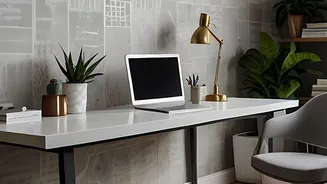
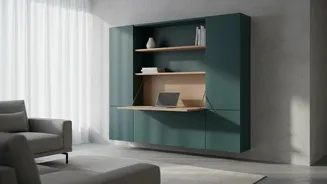
In a small home office, where every square inch counts, task lighting offers outsized benefits. Unlike bulky floor lamps or multiple overhead fixtures, a compact desk lamp delivers powerful light without consuming valuable space. This focused illumination helps to visually define your workstation, creating a designated zone for productivity even if your "office" is just a corner of the living room. It also combats one of the biggest issues in any workspace: glare. A single, poorly positioned overhead light is a primary cause of screen glare, which leads to eye fatigue and headaches. A well-placed task light gives you control, allowing you to illuminate your desk without shining light directly on your monitor.
Choosing the Right Tool for the Task
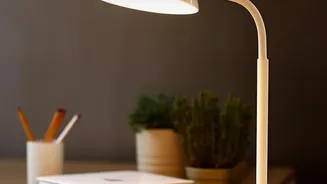
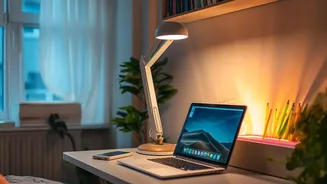
The most common and versatile form of task lighting is the adjustable desk lamp. Look for models with a flexible or articulated arm, allowing you to easily direct light exactly where you need it and move it out of the way when you don't. This adjustability is key to avoiding shadows and glare. If desk space is extremely limited, consider a clamp-on lamp that attaches to the edge of your desk or a nearby shelf. Wall-mounted task lights are another excellent space-saving option. For a clean, modern look, under-cabinet or under-shelf LED strips can provide even, diffused light across your entire work surface without creating clutter.
Positioning for Perfect Illumination
Where you place your task light is just as important as the type of lamp you choose. The primary goal is to illuminate your work without creating distracting shadows or direct glare. A simple rule of thumb is to place the lamp on the side opposite your writing hand. If you are right-handed, position the lamp on your left; if you are left-handed, place it on your right. This prevents your hand and arm from casting a shadow over your work. To combat screen glare, the light source should ideally be to the side of your monitor, not directly behind or in front of it. The light should be angled down onto your desk or documents, not toward your eyes or computer screen.
Decoding the Bulb: Kelvin and Lumens
When selecting a bulb, two terms are crucial: lumens and Kelvin. Lumens measure brightness, while Kelvin (K) measures colour temperature, from warm (yellowish) to cool (bluish-white). For office work, you need enough brightness to see clearly without straining. A light source providing around 500 lumens for the general desk area is a good starting point, though you may want up to 700 for detailed reading. For colour temperature, most experts recommend a neutral or cool white light that mimics natural daylight, as this promotes alertness and focus. Look for bulbs in the 3500K to 5000K range. Anything warmer (below 3000K) can feel too relaxing and induce sleepiness, while anything much cooler (above 5500K) can feel harsh and clinical.