




The Problem with Martian Air
The fundamental challenge for human life on Mars is its atmosphere. While Earth's air is a friendly mix of nitrogen and about 21% life-giving oxygen, the Martian atmosphere is a thin, unbreathable cocktail. It's composed of roughly 96% carbon dioxide
(CO2), a gas humans can't survive on. Transporting all the oxygen needed for a long-term mission from Earth is logistically daunting and prohibitively expensive. To make a sustained human presence feasible, future explorers need a way to generate their own oxygen on-site, a concept known as In-Situ Resource Utilization, or ISRU.
A Groundbreaking First Step: MOXIE
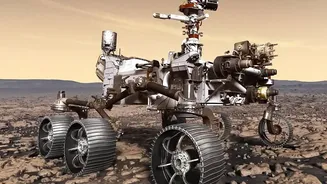
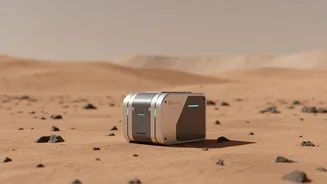
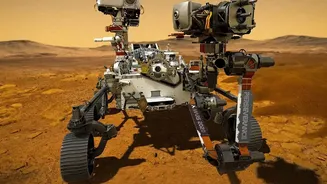
The first major breakthrough in Martian oxygen production came from a lunchbox-sized instrument aboard NASA's Perseverance rover. The Mars Oxygen In-Situ Resource Utilization Experiment, or MOXIE, was designed by a team from MIT to prove that converting Martian CO2 into oxygen was possible. Using a process called solid oxide electrolysis, MOXIE heated the Martian air to about 800 degrees Celsius and electrochemically split the carbon dioxide molecules into oxygen and carbon monoxide. Between 2021 and 2023, MOXIE successfully ran 16 times, proving the technology works in real-world conditions. It produced about 122 grams of oxygen in total — enough for a small dog for about 10 hours — hitting a peak production rate of 12 grams per hour, twice its initial goal.
Scaling Up for Human Missions
While MOXIE was a stunning success, its output was tiny. To support a human crew, a system would need to produce oxygen at the rate of several hundred trees. This is where 'scaled electrolysis systems' come in. The next logical step isn't just a MOXIE 2.0, but a full-scale oxygen plant. Companies like OxEon Energy, which contributed to MOXIE, are already developing stacks with five times the cell area and many more cells, resulting in a device scaled to over 30 times the size of the original. A larger system would be designed for continuous operation, unlike MOXIE which had to power on and off. This constant, high-temperature operation could even make the larger systems more efficient. The goal is to build an autonomous plant that could be sent to Mars ahead of astronauts, working for months to fill large tanks with breathable air and, crucially, liquid oxygen.
More Than Just Breathing Room
The business case for this technology extends far beyond life support. The single biggest need for oxygen on Mars is not for breathing, but for rocket propellant. Getting astronauts off Mars and back to Earth will require an estimated 33 to 50 tons of fuel, and the majority of that mass is the oxidizer—liquid oxygen. Manufacturing this propellant on Mars would radically change the economics of a round trip. It eliminates the need to launch a fully fueled return vehicle from Earth, dramatically reducing the weight and cost of the initial mission. In essence, these scaled-up electrolysis systems are the first step toward creating an interplanetary refueling station, a critical piece of infrastructure for a sustainable presence on Mars and deeper space exploration.
Challenges on the Red Horizon
Despite the promise, significant engineering hurdles remain. A full-scale system needs to be incredibly robust, capable of operating flawlessly and autonomously for thousands of hours in the harsh Martian environment, including extreme temperature swings and dust storms. Power is another major consideration; these systems require a lot of energy, which would likely have to come from large solar arrays or a dedicated nuclear power source. Furthermore, the technology must not only generate oxygen but also include systems to purify, liquefy, and store it under pressure — a complex industrial process that has never been attempted on another world. While MOXIE proved the core science, building a reliable, mission-scale oxygen factory is the next great technological challenge on the path to colonizing Mars.