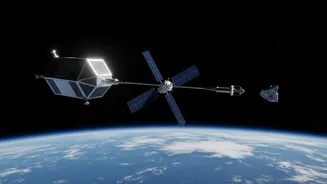







The Junkyard Above Our World
Low Earth Orbit (LEO) is a critical zone for modern life, hosting thousands of satellites for communication, navigation, and Earth observation. But for decades, we've been leaving things behind. Defunct satellites, spent rocket stages, and fragments from
collisions now form a hazardous cloud of debris. Traveling at speeds over 17,000 miles per hour, even a tiny paint fleck can inflict catastrophic damage on an active satellite. The International Space Station, for example, has had to perform dozens of avoidance maneuvers to dodge this orbital shrapnel. Experts warn of a potential chain reaction, known as the Kessler Syndrome, where collisions create more debris, leading to more collisions, potentially rendering parts of orbit unusable.
Enter the Electrodynamic Tether
Imagine a long, incredibly thin, and strong wire unspooling from a satellite. This isn't science fiction; it's the core of electrodynamic tether technology. These tethers, often just a few centimeters wide but potentially kilometers long, are made of a conductive material like aluminum. When attached to a piece of space junk or a retired satellite, they offer a revolutionary way to remove it from orbit without using any propellant, which has long been a major limitation for space missions. Several companies and space agencies, including Japan's JAXA and the European Space Agency (ESA), are actively developing and testing these systems.
Harnessing Earth's Magnetic Field
The genius of an electrodynamic tether is that it uses Earth itself as a giant engine. As the conductive tether orbits the planet, it moves through Earth's magnetic field. This motion induces an electrical current in the wire, a principle of physics known as the Lorentz force. By controlling this current, the tether can generate a force that acts as a brake. This electromagnetic drag slows the satellite or debris down, causing its orbit to decay. Gradually, the object is pulled lower and lower until it re-enters Earth's atmosphere and burns up harmlessly. Because it requires no fuel, a single tether-equipped vehicle could potentially de-orbit multiple pieces of debris over its lifetime.
An Elegant and Efficient Solution
Compared to other proposed solutions like nets, harpoons, or lasers, electrodynamic tethers offer distinct advantages. They are lightweight, compact, and don't require carrying heavy fuel reserves, making them cheaper to launch. The process is also reversible; by running power from solar panels into the tether, it can generate thrust to boost a satellite's orbit, extending its operational life. This dual-use capability makes the technology highly versatile for both debris removal and satellite servicing. Systems like the Terminator Tape, developed by Tethers Unlimited, are designed as passive de-orbit devices that can be attached to satellites before launch, ensuring they can be safely removed at the end of their mission.
The Road to a Cleaner Orbit
The path to a clean LEO is just beginning. Demonstration missions are crucial for proving the reliability and durability of these long tethers in the harsh environment of space. Projects like the European Space Agency's ECO-Tethers study, which is scheduled to conclude in early 2027, are maturing the technology for commercial use. Startups such as PERSEI Space are planning major demonstration missions to prove the system's effectiveness. As thousands of new satellites are launched for mega-constellations, integrating sustainable, propellant-less de-orbiting technology isn't just a good idea—it's essential for the future of the space economy. These magnetic tethers represent a critical tool in ensuring that our activities in space are sustainable for generations to come.