




The Challenge of Building on the Moon
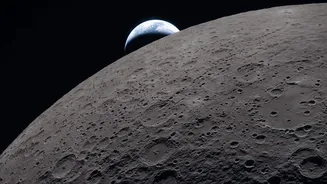
Constructing a habitat on Earth is a known science, but the Moon presents a hostile and alien construction environment. The lunar surface is covered in regolith, a blanket of fine, abrasive, and electrostatically charged dust. This dust isn't like terrestrial
sand; its particles are sharp, like microscopic shards of glass, which can wear down spacesuits and jam mechanical parts. Furthermore, the Moon lacks a protective atmosphere, leading to extreme temperature swings from 127°C in sunlight to -173°C in shadow. This thermal gradient can cause materials to warp and snap. Without a magnetic field, the surface is also bombarded with harmful solar and cosmic radiation. Any permanent structures must withstand these harsh conditions, as well as potential 'moonquakes' and micrometeorite impacts. Building safely requires knowing exactly what you're building on, and right now, crucial data is missing.
From Theory to Foundation: The Need for Ground Truth
For decades, our understanding of the lunar surface came from orbital data and the limited samples returned by Apollo missions. While invaluable, this information lacks the detailed, on-site geotechnical data needed for major construction. Engineers need to understand the regolith's density, composition, and stability to design foundations that won't fail. The presence of water ice, particularly in the permanently shadowed regions of the lunar South Pole, is another critical variable. This ice could be a vital resource for drinking water, oxygen, and rocket propellant, but its exact location, quantity, and accessibility are still largely unknown. Simply put, NASA needs to conduct a detailed 'site survey' before committing to building its Artemis Base Camp. This involves sending robotic missions to gather what scientists call 'ground truth'—direct, on-the-surface measurements that confirm or refine orbital observations.
NASA's Robotic Reconnaissance
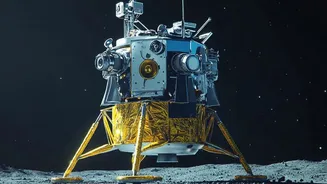
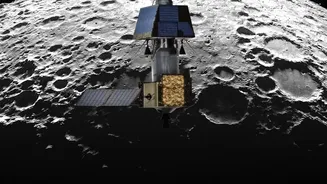
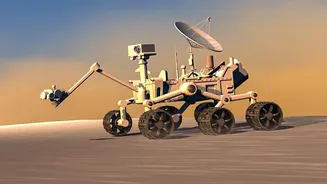
To gather this essential data, NASA is utilizing its Commercial Lunar Payload Services (CLPS) initiative. This program partners with commercial companies to deliver science and technology payloads to the lunar surface. A key part of this effort is the Payloads and Research Investigations on the Surface of the Moon (PRISM) program, which funds the development of specialized instrument suites to address key scientific questions. Recently, NASA announced three new PRISM selections specifically aimed at preparing for a Moon Base. These investigations will act as robotic scouts, assessing environmental hazards, searching for resources, and even looking for natural shelters like lava tubes that could protect future astronauts.
The New Investigations in Focus
The three newly selected payload suites each tackle a different piece of the puzzle. The first, the Lunar Environment Monitoring Station – South Pole (LEMS-SP), is a compact, autonomous station designed to monitor the lunar environment for up to two years. It will use a seismometer to detect moonquakes and micrometeorite impacts, providing a long-term assessment of seismic hazards. The second, named GIMLI (Geophysical Instruments for Marius Lunar pit Investigation), will explore a pit on the Moon to see if it leads to a subterranean lava tube. Such underground caves could offer natural protection from radiation and extreme temperatures for future habitats. The third, DISCO (Depth Imager with Spectral and Color Optics), will provide the first direct, on-the-ground measurements of ice hidden in small, shadowed craters. It will also study how stable the lunar soil is, which is critical for planning rover routes and understanding how rocket exhaust might impact the surface during landings.