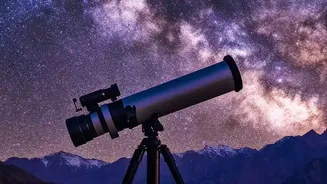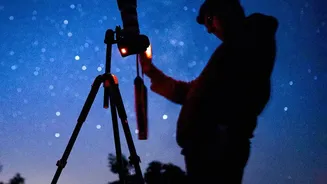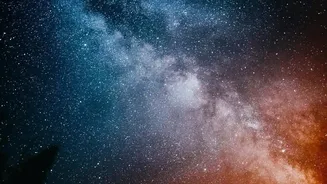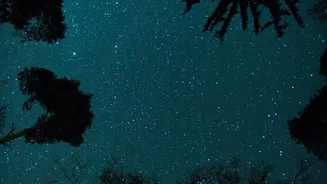





For most urban Indians, a truly dark night sky is a distant memory. But beyond the city haze, India is home to some of the planet's most spectacular stargazing spots, where the Milky Way still blazes across a canvas of thousands of stars.
Understanding the Enemy: Light Pollution
Before you can
find a dark sky, you need to know what you're running from. Light pollution, the excessive and misdirected artificial light from cities and towns, creates a 'sky glow' that washes out all but the brightest stars. Astronomers measure sky darkness using the Bortle Scale, a nine-level system where Class 1 is a pristine, pitch-black sky and Class 9 is a major city centre where only the moon and a few planets are visible. Most Indian cities fall between Class 7 and 9. The destinations on this list are typically in the Bortle Class 1 to 4 range, offering a celestial view that is simply impossible in urban areas.
Hanle, Ladakh: India's Celestial Sanctuary
Topping nearly every list is Hanle in Ladakh, home to India's first and only officially designated Dark Sky Reserve. Situated at a breathtaking altitude of 4,500 metres within the Changthang Wildlife Sanctuary, Hanle offers Bortle Class 1 skies—the darkest possible rating. The air here is incredibly dry and thin, providing exceptionally clear nights. This is why it hosts the Indian Astronomical Observatory. On a moonless night, the Milky Way is so bright it can cast a faint shadow. Local villagers have been trained as 'Astronomy Ambassadors' to guide visitors, making a trip here a community-supported venture. Plan your visit between May and October, avoiding the full moon for the best experience.
Spiti Valley, Himachal Pradesh: High-Altitude Grandeur
A close contender for India's best stargazing spot is the high-altitude cold desert of Spiti Valley. With an average elevation of over 12,500 feet, villages like Kibber, Kaza, and Langza offer pristine Bortle Class 1 or 2 skies. Its remote location and rain-shadow geography mean cloud-free nights are common, especially from June to October. The iconic Buddha statue at Langza, silhouetted against the galactic core, has become a bucket-list shot for astrophotographers. You don't need a telescope here; the Milky Way and even the Andromeda Galaxy can be visible to the naked eye on clear nights.
The Andaman Islands: Coastal Cosmos
For a completely different stargazing experience, head to the Andaman and Nicobar Islands. Far from the mainland's pollution, islands like Havelock (Swaraj Dweep) and Neil (Shaheed Dweep) offer dark, unobstructed horizons over the Bay of Bengal. The lack of industrial development and low population density contribute to minimal light pollution. The best time to visit is during the dry season, from November to March, when clear tropical skies prevail. Imagine lying on a quiet beach like Radhanagar or Laxmanpur, listening to the waves as you watch meteor showers streak across a star-filled sky.
Coorg, Karnataka: Southern India’s Starry Escape
You don't have to go to the Himalayas to find dark skies. Nestled in the Western Ghats, Coorg (Kodagu) offers some of the best stargazing in southern India. Its high elevation, clean air, and low light pollution create excellent viewing conditions, especially in areas away from the main towns of Madikeri and Virajpet. Some southern valleys near the Brahmagiri foothills boast Bortle Class 2 skies. The clear season runs from November to May, with the Milky Way becoming prominent from February onwards. Several local observatories and resorts offer guided sessions with powerful telescopes, making it an accessible option for beginners and families.
Rann of Kutch, Gujarat: A Surreal Starscape
The vast, flat expanse of the Great Rann of Kutch provides a surreal and unique stargazing backdrop. This white salt desert is far from major urban centres, offering excellent Bortle Class 2–3 skies. During the winter months, especially around the new moon, the white salt crust can faintly reflect the starlight, creating an otherworldly feeling of being inside a celestial sphere. The popular Rann Utsav festival (typically November to February) coincides with the best stargazing season, allowing you to combine a cultural trip with a cosmic one.