



First, What Is a Pulsar?
Before diving into the map, it’s helpful to know what you’re looking for. A pulsar is a type of neutron star, which is the incredibly dense, collapsed core left behind after a massive star explodes. A teaspoon of neutron star material would weigh as much
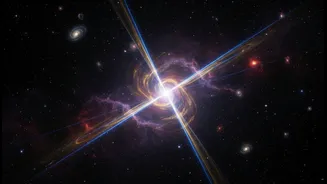
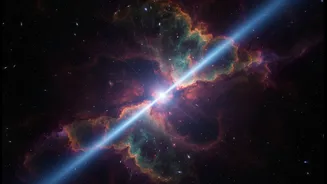
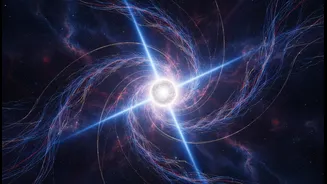
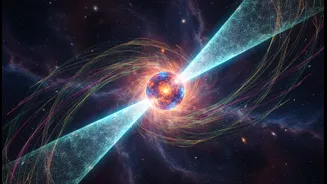
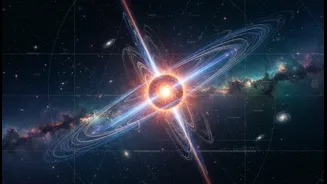
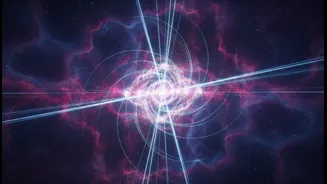
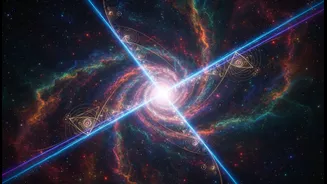
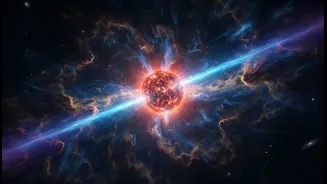
as a mountain. What makes a pulsar special is its rapid spin and intense magnetic field. This combination creates powerful beams of radiation that shoot out from its magnetic poles. As the pulsar rotates, these beams sweep across the cosmos. If one of those beams happens to sweep past Earth, our telescopes detect a regular pulse of energy. This is why pulsars are often called 'cosmic lighthouses,' with their steady, rotating beams appearing to flash on and off from our perspective.
Understanding the 'Map' Concept
The idea of a 'pulsar map' isn't new, but the way NASA uses it has evolved. You might have heard of the famous Pulsar Map included on the Voyager spacecraft's Golden Record. That map, designed by astronomers Carl Sagan and Frank Drake, used the positions of 14 known pulsars to triangulate the location of our solar system, serving as a potential guide for any intelligent life that might one day find the probe. It was a map for others to find us. Today, when we talk about NASA's pulsar maps, we are referring to the sophisticated digital tools and data visualizations the agency uses to understand the pulsars themselves and the universe they inhabit. This includes mapping their surfaces and the magnetic fields that surround them.
Mapping an Icon: The Lighthouse Nebula
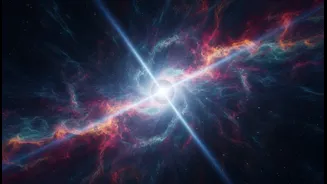
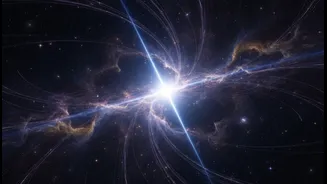
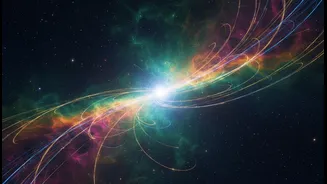
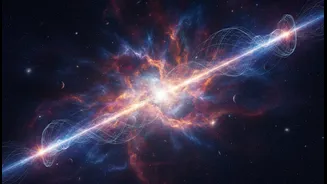
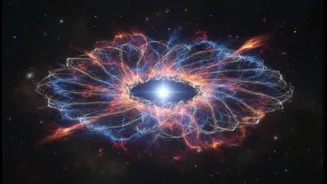
Recent excitement in the astronomy community has centered around a specific object known as the Lighthouse Nebula and its central pulsar, PSR J1101−6101. Using the Imaging X-ray Polarimetry Explorer (IXPE) telescope, scientists have for the first time been able to directly map the magnetic field structure of this system. This work, conducted in 2025, confirmed theories about how high-energy particles escape from the pulsar and interact with the galaxy's magnetic field. This isn't a map you can browse like a street map, but rather a scientific achievement that helps us understand the fundamental physics of these extreme objects. By studying the polarization of X-rays from the nebula, NASA scientists are effectively creating a map of its invisible magnetic heart, revealing the forces that shape these beautiful and complex structures.
Your Guide to Exploring Pulsars at Home
So, how can you use NASA’s resources to explore these cosmic lighthouses yourself? While there isn't a single public-facing 'Lighthouse Pulsar Map' to click through, NASA provides a galaxy's worth of data and visualizations. A great place to start is the official NASA Science website, which features detailed explainers and the latest news on pulsar discoveries. For a more visual journey, NASA's Goddard Space Flight Center Scientific Visualization Studio offers stunning animations based on real data from telescopes like Fermi and NICER, which show how pulsars emit gamma-rays and X-rays. These visualizations often illustrate the lighthouse effect and even show maps of pulsar hotspots. Furthermore, exploring the websites for missions like the Chandra X-ray Observatory and IXPE will give you access to the raw images and data analyses that scientists use, often accompanied by articles that break down what it all means.
What You Learn from the Data
By engaging with these resources, you can learn about more than just blinking stars. Pulsars are natural laboratories for studying physics under conditions that are impossible to replicate on Earth. The data from these objects help scientists test Albert Einstein's theory of general relativity, understand the state of ultra-dense matter, and learn how magnetic fields behave at unimaginable strengths. The timing of pulsar signals is so precise that they can be used to detect gravitational waves rippling through spacetime. Each dataset, image, and animation is a piece of a grander map—one that charts the frontiers of human knowledge and our understanding of the universe's most extreme inhabitants.