


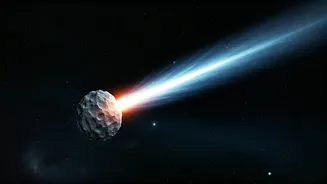
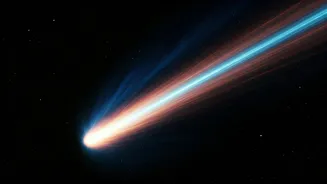
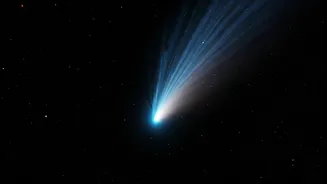


An Unexpected Guest from Deep Space
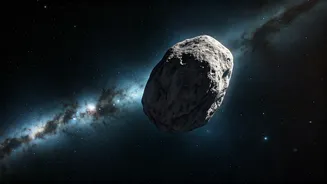
On July 1, 2025, the ATLAS sky survey system in Chile spotted a faint object moving in a way that didn't quite make sense. Unlike the predictable, looping orbits of comets and asteroids born in our own cosmic backyard, this object was on a one-way trip.
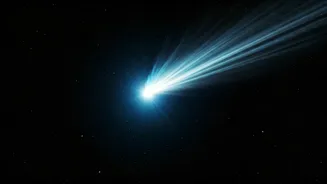
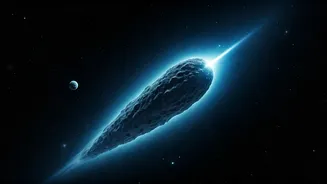
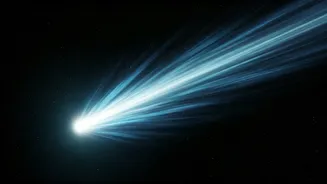
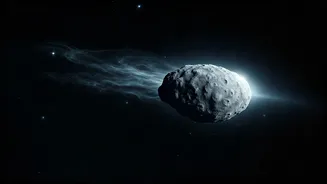
Its trajectory was a clear giveaway: it was moving too fast to be captured by our Sun's gravity, meaning it came from interstellar space. Dubbed 3I/ATLAS, it became only the third confirmed interstellar object ever detected. After the enigmatic, cigar-shaped 'Oumuamua and the more conventional comet 2I/Borisov, astronomers were thrilled to have a new subject. What they found, however, was far stranger than they could have anticipated.
A Relic Older Than the Sun
The first clues that 3I/ATLAS was special came from its flight path. Its angle of approach suggested it didn't come from the flat plane where most stars in our galactic neighbourhood reside, but from the Milky Way's 'thick disk'—a halo of much older stars. This led to a startling hypothesis, later supported by detailed analysis, that the comet could be around 7 billion years old, and perhaps even as old as 10 to 12 billion years. For context, our own solar system is a relative newcomer at just 4.6 billion years old. This traveller isn't just from another star; it's a messenger from a long-lost era of the galaxy's history, carrying a snapshot of the chemical conditions that existed before our world was even a glimmer in the cosmos.
A Bizarre Chemical Cocktail
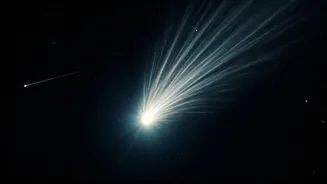
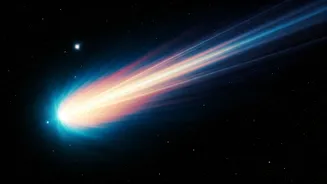
As astronomers turned their most powerful tools, like the James Webb and Hubble Space Telescopes, towards the visitor, the mystery deepened. The light filtering through the gas and dust cloud, or coma, surrounding the comet revealed a bizarre chemical fingerprint. It was unusually rich in carbon dioxide and had a strange ratio of nickel to iron compared to comets from our system. The biggest surprise was the water. Webb's instruments detected exceptionally high levels of 'heavy water,' which contains a heavier type of hydrogen called deuterium. Finding nearly 30 times the amount seen in local comets strongly suggests 3I/ATLAS formed in an extremely cold, ancient environment, far different from our own.
The Global Race to Understand
The comet's fleeting visit, peaking with its closest pass to the Sun in October 2025 and Earth in December 2025, triggered a global scientific sprint. From ground-based observatories to space probes already stationed across the solar system, every available instrument was aimed at the object. ESA's Juice mission, on its way to Jupiter, and orbiters around Mars all collected data as the comet flew by. It was a coordinated, international effort to capture as much information as possible before 3I/ATLAS sped away, destined to return to the darkness between the stars, never to be seen again. This wasn't just about one object; it was a fire drill for how to study future interstellar visitors.
More Interesting Than Aliens
Whenever an object with unusual properties appears, whispers of 'aliens' are never far behind. Some noted the comet's strange chemistry and other anomalies as potential red flags. However, the scientific consensus is clear: 3I/ATLAS is a natural object, and its weirdness is precisely what makes it so valuable. The unusual composition isn't a sign of industrial manufacturing; it's a pristine sample of a star system that formed billions of years ago under conditions we can only imagine. It provides a rare, direct measurement of the building blocks of another world, offering profound insights into how common—or how unique—our own solar system might be.