


A Unique Perch in Space
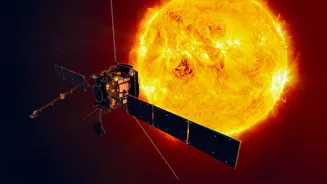
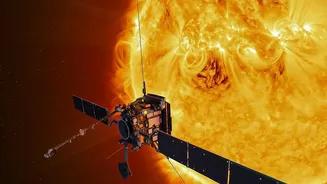
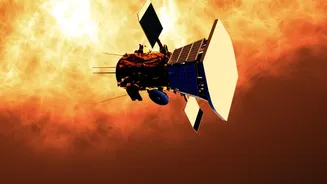
To track a solar eruption, you first need a clear, constant view. This is Aditya-L1's primary advantage. The probe is positioned at Lagrange Point 1 (L1), a spot 1.5 million kilometres from Earth where the gravitational pulls of the Sun and Earth balance
out. From this halo orbit, the spacecraft can watch the Sun continuously, without any eclipses or occultations caused by the Earth or Moon getting in the way. This uninterrupted observation is critical for tracking the full lifecycle of a solar event, from its initial spark to its departure from the Sun's atmosphere.
Creating an Artificial Eclipse
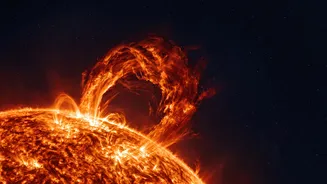
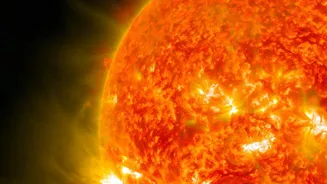
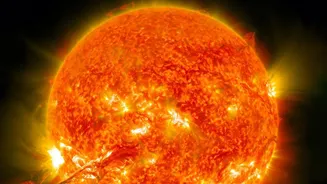
The Sun's surface is so bright that it completely outshines its faint outer atmosphere, the corona. This is where the most violent eruptions originate, but seeing it is like trying to spot a firefly next to a searchlight. Aditya-L1's main instrument, the Visible Emission Line Coronagraph (VELC), solves this problem by creating a perpetual artificial eclipse. It blocks the direct light from the Sun's disk, allowing it to image the much dimmer corona. This enables VELC to capture the very first moments a Coronal Mass Ejection (CME)—a massive blob of plasma and magnetic field—erupts from the Sun. Scientists can study how these CMEs form and accelerate, providing crucial early warnings.
A Multi-Wavelength View of the Action
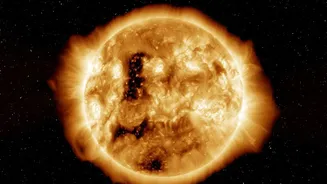
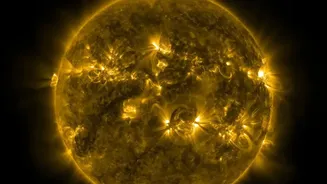
An eruption isn't just one event; it's a complex process that unfolds across different layers of the Sun's atmosphere. Aditya-L1 is equipped with a suite of instruments to see the full picture. The Solar Ultraviolet Imaging Telescope (SUIT) captures full-disk images of the Sun's photosphere and chromosphere in near-ultraviolet wavelengths. These layers lie beneath the corona, and observing them helps scientists see the activity on the surface that triggers a larger eruption above. By combining data from SUIT with X-ray detectors like SoLEXS and HEL1OS, which spot the high-energy flashes of solar flares, scientists can connect the 'cause' on the surface with the 'effect' in the corona.
Tasting the Solar Wind
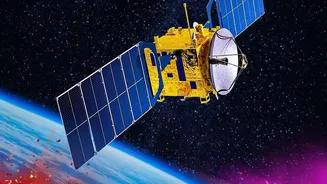
Aditya-L1 doesn't just watch from a distance; it also has instruments to 'taste' what's coming. Four of its seven payloads perform remote sensing (like VELC and SUIT), while three conduct 'in-situ' measurements, studying the particles and magnetic fields that actually reach the spacecraft. Instruments like the Aditya Solar wind Particle Experiment (ASPEX) and the Plasma Analyser Package for Aditya (PAPA) directly sample the solar wind—the constant stream of charged particles flowing from the Sun. When a CME passes by, these instruments measure the change in speed, density, temperature, and composition of the particles, giving scientists direct data on the eruption's properties as it travels through space.
Protecting Our Technology on Earth
This comprehensive tracking isn't just for scientific curiosity. Extreme solar eruptions can have severe consequences on Earth and in orbit. A powerful CME can disrupt satellite communications, damage GPS systems, create hazards for astronauts, and even induce currents that overload power grids on the ground, causing widespread blackouts. By providing an early and detailed look at the origin and trajectory of these eruptions, Aditya-L1's data is vital for improving our space weather forecasting models. This advanced warning gives satellite operators, airlines, and power grid managers crucial time to take protective measures, safeguarding the technology we all depend on.