







What Are Perovskite Solar Panels?
Think of solar panels as a sandwich that catches sunlight and turns it into electricity. For decades, the main ingredient has been highly purified silicon. Perovskite solar panels use a different material for this crucial layer, one with a unique crystal
structure. This family of materials, named after a Russian mineralogist, is incredibly effective at absorbing light. What truly makes them a breakthrough is not just their efficiency, but how they are made. Unlike silicon, which requires high temperatures and energy-intensive processes to produce, perovskite crystals can be 'printed' or coated in thin layers at low temperatures, almost like ink. This fundamental difference is the key to their revolutionary potential.
The Big Deal: Cheaper and More Versatile
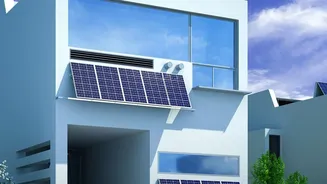
The main advantage of perovskites boils down to cost and flexibility. Manufacturing silicon panels is a complex, expensive process. Perovskite production, on the other hand, is simpler and uses cheaper, more abundant raw materials. Some analyses project that as manufacturing scales up, perovskite panels could become significantly cheaper than their silicon counterparts. Beyond cost, their physical properties are a major draw. Because they can be made into ultra-thin, flexible, and lightweight films, perovskites open up a world of possibilities that are difficult for rigid silicon panels. Imagine solar-collecting films applied to windows, vehicle roofs, or even the walls of buildings. One Indian startup, P3C Technology, is already developing flexible perovskite substrates alongside more traditional glass panels.
The Race for Efficiency
In the solar world, efficiency is everything — it's the measure of how much sunlight a cell converts into usable electricity. While traditional silicon panels have improved steadily, perovskites have seen a meteoric rise in efficiency in research labs, rivaling and even surpassing silicon in a fraction of the time. The most exciting development is the 'tandem' cell, which stacks a perovskite layer on top of a silicon one. The perovskite layer captures high-energy visible light, while the silicon layer captures lower-energy infrared light. This one-two punch allows tandem cells to break through the efficiency ceiling of silicon alone, with some lab prototypes exceeding 33% efficiency—a huge leap from the 20-25% typical of most commercial silicon panels today.
The Hurdles: Durability and Scale
If perovskites are so amazing, why aren't they on every roof? The primary challenge has been durability. Early perovskite cells degraded quickly when exposed to moisture, heat, and UV light — three things solar panels see every day. While a standard silicon panel is warrantied for 25-30 years, early perovskite models lasted only a few years. Researchers have made huge strides in stability with better encapsulation and new chemical formulas, but proving long-term, real-world reliability is the final frontier. Another hurdle is scaling up production from small lab cells to large, uniform, factory-made modules without losing efficiency, a challenge that companies are now beginning to solve. Finally, many perovskite formulas contain lead, raising environmental concerns that researchers are working to address by either replacing it or ensuring it can be safely contained.
The Road to Your Rooftop
So, when can you expect to install these on your home in India? The transition is already beginning. As of 2026, several companies globally have started pilot production lines and early commercial deployments. Chinese manufacturer GCL, for instance, is ramping up a 500 MW production line with plans to ship commercial modules by late 2026. However, widespread availability for residential customers is still a few years away. Experts believe tandem perovskite-silicon cells will be the first to hit the mainstream market, as they build on existing silicon manufacturing infrastructure. With India's ambitious solar goals, including the PM Surya Ghar Yojana aiming to solarize 10 million households, the arrival of a cheaper, more efficient technology will be a game-changer for the nation's energy independence.