







Gravity Isn't a Force, It's a Bend
Forget the old idea of gravity as an invisible rope pulling objects together. In 1915, Einstein's theory of general relativity reframed it entirely. He revealed that space and time are fused into a single, four-dimensional fabric called spacetime. [3,
23] Massive objects don't pull on other objects; instead, they bend and curve this fabric around them. [12, 20] The classic analogy is a bowling ball placed on a stretched rubber sheet. [12] The ball creates a dip, and a marble rolled nearby will spiral inward, not because of a mysterious attraction, but because it's following the curve in the sheet. [12] What we feel as gravity is simply our path through this warped spacetime. [12, 25]
How Gravity Warps Time
This warping of spacetime doesn't just affect space; it also affects time. According to Einstein, the stronger the gravity, the slower time passes. [6, 9] This phenomenon is known as gravitational time dilation. [9] While the effect is minuscule for everyday objects, it's a measurable reality. Clocks on GPS satellites, which are farther from Earth's gravitational pull, actually run slightly faster than clocks on the ground. [10, 17] Engineers must constantly correct for this discrepancy to ensure GPS navigation remains accurate. [17] The closer you get to a massive object, the more pronounced this time-slowing effect becomes. [15]
Black Holes: The Ultimate Time Warpers
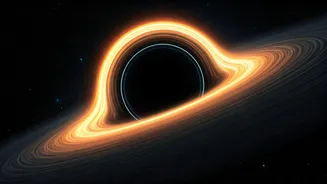
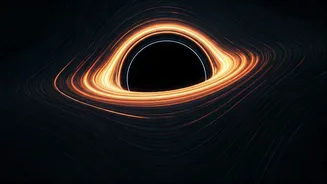
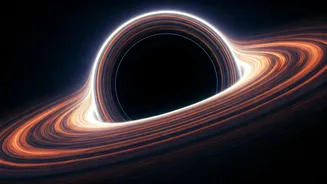
Black holes are what happen when an immense amount of matter is squeezed into an incredibly tiny space, creating a gravitational field so powerful that nothing, not even light, can escape. [1, 16] They represent the most extreme curvature of spacetime known in the universe. [13, 21] Near a black hole, the warping is so severe that the flow of time is dramatically altered. For an observer falling into a black hole, time would seem to pass normally. But to someone watching from a safe distance, the falling observer would appear to slow down, seemingly freezing in time as they approach the edge, known as the event horizon. [15, 19]
Getting Stretched Like Spaghetti
The "stretching" part of the headline is also a very real, albeit terrifying, concept known as spaghettification. [1, 2] This occurs because the gravitational pull of a black hole increases dramatically over very short distances. [5, 7] If you were to fall in feet-first, the gravity pulling on your feet would be vastly stronger than the pull on your head. [2, 8] This immense difference in force, known as a tidal force, would stretch your body vertically while compressing it horizontally, elongating you into a long, thin stream of particles, much like a noodle of spaghetti. [2, 7] While this would happen before you even reached the event horizon of a smaller, stellar-mass black hole, you might briefly survive crossing the boundary of a supermassive one before being torn apart. [2, 18]