







The Promise and Peril of Lithium-Metal
For years, the battery powering your smartphone and today’s electric cars has been a lithium-ion unit. It’s a reliable workhorse, but its core design is reaching its limits. The anode, one of the key components, is typically made of graphite, which is stable
but can't hold as much energy as scientists would like. This limitation is what leads to 'range anxiety' in EV owners and the long wait times at charging stations. The holy grail for battery researchers is to replace that graphite anode with pure lithium metal. A lithium-metal anode has an exceptionally high theoretical energy density, potentially holding up to 10 times more energy than graphite. This could translate to EVs that travel much farther on a single charge or batteries that are significantly lighter and smaller, revolutionizing vehicle design. But there’s a catch: lithium metal is highly reactive and notoriously unstable.
The Dendrite Problem
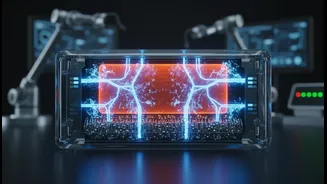
The primary villain in the lithium-metal battery story is the 'dendrite'. As the battery charges, tiny, sharp, tree-like metallic structures can grow from the lithium-metal anode. These dendrites can pierce the separator that divides the battery's positive and negative sides, causing a short circuit. This not only kills the battery but can also lead to overheating and fire, posing a significant safety risk. This single, persistent problem has hindered the commercial deployment of rechargeable lithium-metal batteries for decades, keeping this powerful technology largely confined to the lab. Solving the dendrite issue has become the central focus for scientists and engineers aiming to unlock the next generation of energy storage.
A Breakthrough in Electrolyte Engineering
Recent breakthroughs are offering a clearer path forward, centered on redesigning the battery's other critical component: the electrolyte. The electrolyte is the medium that allows lithium ions to flow between the anode and cathode. In most current batteries, it's a flammable liquid. New research focuses on 'electrolyte engineering' to create a more stable environment that suppresses dendrite growth. Strategies include developing novel electrolyte additives, creating 'weakly solvating' electrolytes that form a more stable interface, and using high-concentration electrolyte formulations. Another major push is toward solid-state electrolytes—using a solid, often ceramic-based, material instead of a liquid. These solid materials are not only non-flammable, enhancing safety, but can also be mechanically strong enough to physically block dendrites from penetrating. Recent studies have shown that techniques like adding a nanoscopic silver coating or applying a temperature gradient can make these solid electrolytes even more resistant to fractures caused by dendrites.
Impact on Future Mobility
The successful implementation of these new designs would be transformative for 'future mobility'. For electric vehicles, it means addressing the biggest consumer pain points. Higher energy density could lead to EVs with ranges well over 800 kilometres, effectively eliminating range anxiety. Faster charging times become possible because lithium-metal anodes and solid electrolytes can handle higher currents without degrading. Furthermore, the enhanced safety profile of solid-state batteries reduces the risk of fires, a key concern for consumers and manufacturers alike. This leap in performance and safety would accelerate EV adoption, making electric transport more practical, affordable, and appealing to a mass market. The technology also has implications for other sectors, including consumer electronics and even future electric aviation.
The Road to Commercialization
While these laboratory breakthroughs are incredibly promising, bringing these advanced batteries to the showroom floor will take time. Researchers still need to validate these designs over thousands of charge cycles under real-world conditions. Manufacturing solid-state batteries at scale presents its own set of challenges, and costs are currently high. However, the momentum is undeniable. Major automotive and battery companies are investing heavily, with some predicting the first limited commercial deployment of these next-generation batteries in vehicles between 2027 and 2030. The journey from a new design to mass production is complex, but the path toward a future of safer, longer-lasting, and more powerful batteries is finally becoming clear.