


Meet the Cosmic Oddball
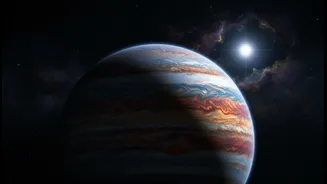
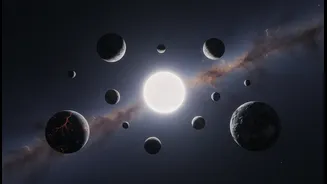
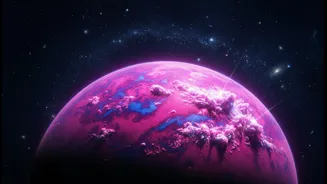
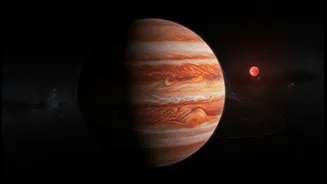
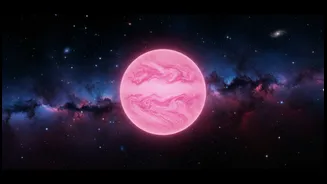
The planet in question is WD 1856 b, a gas giant roughly the size of Jupiter. What makes it truly strange is its companion: a white dwarf, which is the tiny, incredibly dense core left behind after a star like our Sun dies. Discovered in 2020 using data
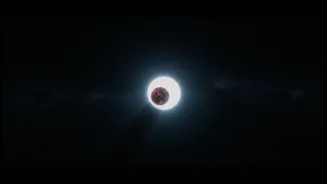
from NASA's TESS and Spitzer telescopes, this system presents a bizarre picture: a planet that is seven times larger than the star it orbits. It circles this stellar remnant at an astonishingly close distance, completing an orbit in just 34 hours—a year on this world is less than two Earth days.
A Planet That Shouldn't Exist
According to our understanding of stellar evolution, WD 1856 b should have been destroyed billions of years ago. When its star reached the end of its life, it would have swelled into a massive red giant, engulfing and incinerating any planets in its inner system. Mercury and Venus in our own solar system face this exact fate in about five billion years. The orbit of WD 1856 b is so tight—about 50 times closer than Earth is to the Sun—that it lies deep within this historical destruction zone. Its very existence is a puzzle that has challenged astronomers and hinted at a dramatic past.
Solving a Celestial Mystery
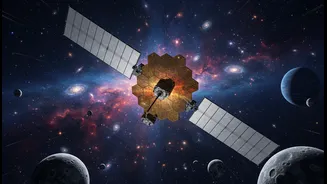
So how did it survive? Recent observations from the James Webb Space Telescope have provided crucial clues. By analysing the planet's atmosphere, scientists have developed a leading theory. WD 1856 b likely did not start its life so close to its star. Instead, it probably spent billions of years in a much wider, safer orbit, far from the star's violent end-of-life expansion. Much later, after the star had collapsed into a stable white dwarf, something nudged the planet inward. The star system is part of a triple-star arrangement, and gravitational kicks from the two distant companion stars are the most likely culprits for pushing WD 1856 b into its current, tight orbit. Its journey inward would have generated immense heat from gravitational forces, which explains why the planet is warmer than it should be today.
A Glimpse of Our Solar System's Future
This is where the "time capsule" idea comes into play. The story of WD 1856 b isn't just about a distant world; it's a preview of our own cosmic destiny. Our Sun is on the same path to becoming a white dwarf. While our inner planets will be lost, the fate of giants like Jupiter and Saturn has been a matter of speculation. WD 1856 b provides the first tangible evidence that large planets can survive their star's death and even migrate into new orbits around the stellar remnant. Studying its atmosphere, which contains methane and haze, gives us a real-world laboratory to understand the chemistry and physics of planets in these late-stage systems. It’s a way of looking forward in time to see what may become of the outer giants in our own celestial neighbourhood.