







The Unparalleled Heartbeat of Puri
The Rath Yatra of Puri is the original, a spectacle of faith on a scale that is hard to comprehend. [8, 27] Considered the world's oldest and largest chariot festival, it commemorates Lord Jagannath's annual journey, along with his siblings Balabhadra
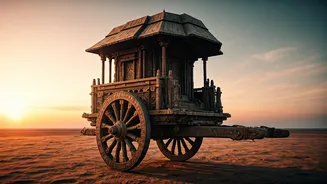
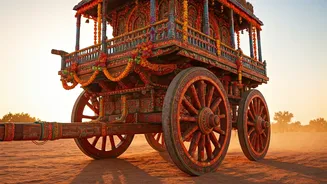
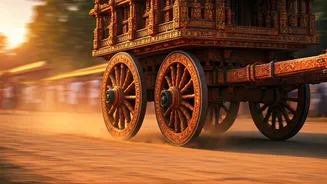
and Subhadra, from their home in the Jagannath Temple to the Gundicha Temple, said to be their aunt's residence. [7, 24] The three massive wooden chariots are newly constructed each year, a sacred craft passed down through generations. [8, 32] Millions of devotees gather to pull the heavy ropes, an act believed to cleanse one of sin and bestow divine grace. [10] The festival, with its intricate rituals like the 'Pahandi' (the ceremonial procession of the deities) and the 'Chera Pahara' (the symbolic sweeping of the chariots by the Puri King), sets the standard for devotion and tradition that has been followed for centuries. [10, 11] Its influence is so profound that the English word 'juggernaut' originates from the unstoppable force of Jagannath's chariot. [7]
Ahmedabad's Grand Legacy
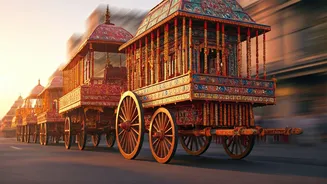
Second only to Puri in scale and antiquity, the Ahmedabad Rath Yatra is a monumental event in its own right. [6, 18] Started in 1878 by Mahant Narsinhdasji Maharaj, this procession has its own deep-rooted traditions and legends. [6, 9] The yatra here is also seen as the day Lord Jagannath ventures out to bless the public. [6] The 18-kilometre procession starts from the 400-year-old Jagannath Temple in the Jamalpur area, winding its way through the city. [12, 18] A key ritual is the 'Pahind Vidhi', where the Chief Minister of Gujarat performs the symbolic cleaning of the path with a golden broom, signalling the start of the yatra. [6, 9] The procession is a grand affair, featuring not just the three main chariots but also decorated elephants, trucks with cultural tableaux, and traditional gymnasiums ('akharas'). [12, 18]
The ISKCON Movement: Taking the Chariots Everywhere
Much of the festival's modern expansion beyond Odisha can be credited to the International Society for Krishna Consciousness (ISKCON). [13] In 1972, ISKCON replicated the grand tradition in Kolkata, which has since become one of the country's biggest celebrations, with a chariot procession winding its way to a week-long festival ground. [15] But their influence didn't stop there. The founder of ISKCON, A. C. Bhaktivedanta Swami Prabhupada, organised the first Rath Yatra outside India in San Francisco in 1967. [21] Today, ISKCON holds hundreds of Rath Yatras in over 100 countries, from London and New York to Johannesburg and Brisbane, transforming a uniquely Indian festival into a global phenomenon. [21, 25] While ISKCON aims to adhere to Puri's traditions, the logistics of holding these events abroad sometimes lead to celebrations outside the traditional dates, a point of discussion with temple authorities in Puri. [20, 22]
Delhi's Devotional Display
The nation's capital also embraces the chariot festival with great fervour. Delhi's oldest Jagannath Temple, established in Thyagraj Nagar in 1968, serves as a major hub for the celebrations. [16] The Delhi Rath Yatra brings a strong Odia cultural presence to the capital, featuring authentic rituals that closely mirror those in Puri. [16, 30] The procession moves from the Jagannath Mandir to a symbolic Gundicha Mandir, drawing large crowds of devotees. [26] In a landmark development for 2026, the temple is planning to celebrate with three separate grand chariots for the first time in Delhi's history, expecting to draw over 1.5 lakh devotees in a multi-kilometre procession. [16] These celebrations showcase how the tradition has found a significant and growing home in the heart of modern India, blending devotion with cultural pride. [29]
A Tapestry of Regional Traditions
Beyond these major hubs, the Rath Yatra map of India is dotted with numerous other significant celebrations. West Bengal, for instance, has a very old history of the festival. The Rathayatra in Mahesh, Serampore, is said to have started in the 14th century, making it the oldest in Bengal and second-oldest in India after Puri. [33] Various other towns in Bengal like Guptipara and Rajbalhat also have their own unique chariot festival traditions. [15] Even smaller temples, like the Jagannath Temple in Kolkata's Khidderpore area, hold their own processions, adding to the city's festive fabric. [34] From major urban centres to smaller towns, the journey of Lord Jagannath's chariot has become a unifying event, a symbol of devotion that adapts to its local environment while staying connected to its ancient origins. Each yatra, big or small, adds a unique brushstroke to this ever-expanding cultural canvas.