


A Cosmic Mystery in Red
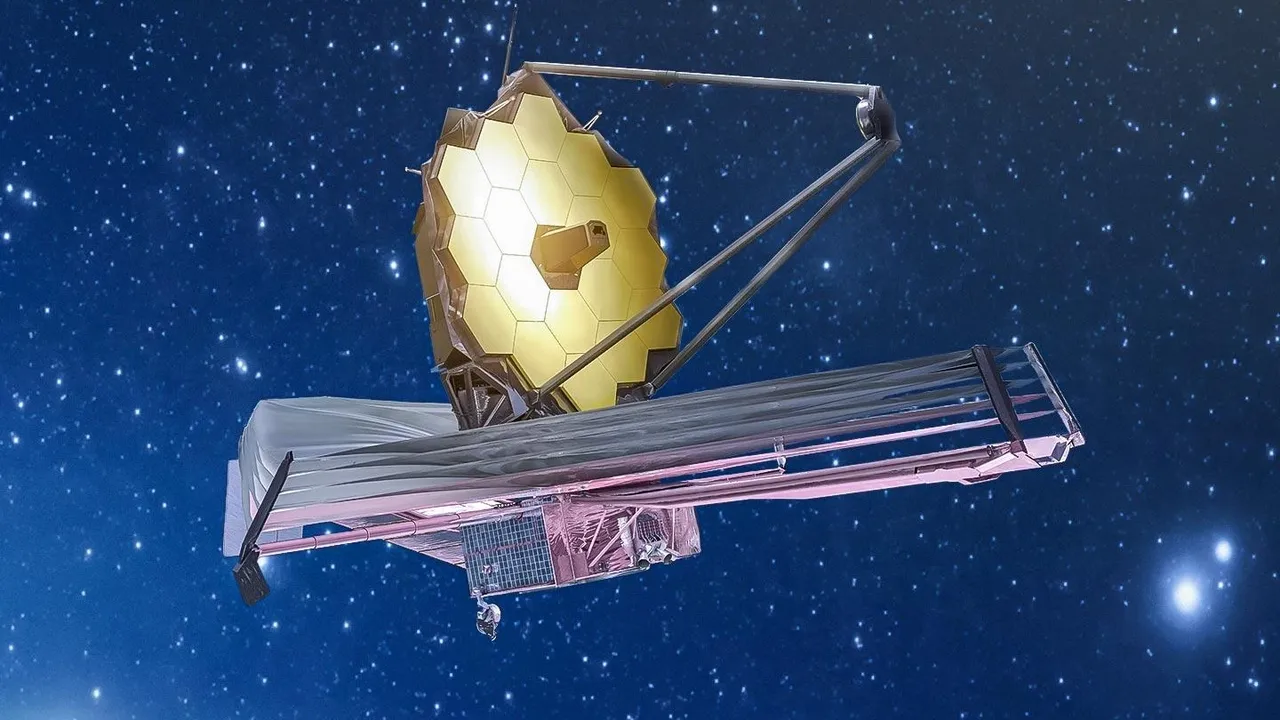
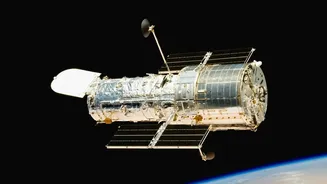
When the James Webb Space Telescope first powered on in 2022, it opened a new window into the dawn of time. Among its first discoveries were peculiar, compact objects that appeared as faint red specks. Their colour was a critical clue, a phenomenon known
as redshift, indicating they were incredibly distant and therefore ancient, existing when the universe was less than a billion years old. Scientists were captivated. They appeared in large numbers in the early cosmos but seemed to vanish as the universe aged, adding to their mystique. Initial theories suggested they were young, dusty galaxies furiously forming stars, a plausible but not entirely satisfying explanation. The evidence wasn't a perfect fit, and the mystery of the little red dots deepened.
The Smoking Gun: A Deeper Look
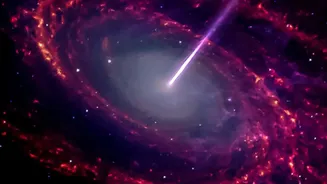
The latest studies have provided the strongest evidence yet about the true nature of these objects. Using Webb's powerful spectrographs, which split light into its component wavelengths like a prism, astronomers analyzed the light coming from these dots in unprecedented detail. One study focused on an object named GLIMPSE-17775, capturing the deepest spectrum of a little red dot to date. What they found were the tell-tale signs of an active supermassive black hole. The light signature revealed gas swirling at immense speeds, a classic indicator of material being pulled into a black hole's accretion disk. This evidence points not to a galaxy full of stars, but to a quasar—an intensely bright and compact region at the center of a galaxy, powered by a feeding supermassive black hole.
Too Big, Too Soon
This discovery solves one mystery but creates a much bigger one. According to our current understanding of cosmology, supermassive black holes take billions of years to grow. They start from the remnants of massive stars and gradually accumulate matter over cosmic eons. Yet, Webb is finding these behemoths—some with masses millions or even billions of times that of our sun—when the universe was in its infancy, only 600 to 800 million years old. In some cases, the black hole's mass appears to be far greater than its host galaxy's, sometimes even exceeding the stellar mass entirely. This completely flips the script on the classic 'chicken-and-egg' question of whether galaxies or their central black holes form first; the evidence increasingly suggests the black holes came first.
Rewriting the Story of the Universe
The existence of these 'overmassive' black holes so early in cosmic history forces scientists to rethink fundamental theories of cosmic evolution. How did they get so big, so fast? One leading theory is that the first black hole 'seeds' were much larger than previously assumed, perhaps forming from the direct collapse of massive gas clouds rather than individual stars. Another recent study proposes that some little red dots are not isolated objects but the incredibly bright, active cores of much larger galaxies whose fainter structures are simply beyond Webb's detection limit at such extreme distances. This suggests the dots may be a temporary, hyperactive phase in a galaxy's life, which explains why they seem to disappear as the universe evolves.