




A New, Wider Eye on the Cosmos
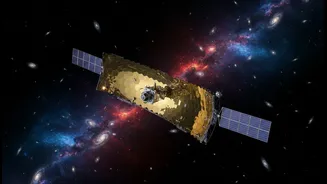
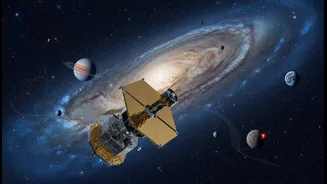
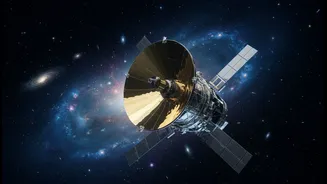
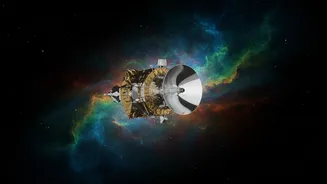
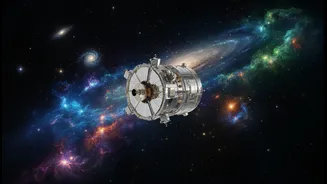
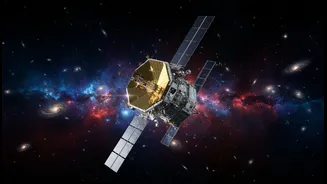
Scheduled for launch on August 30, 2026, the Nancy Grace Roman Space Telescope is not just another space telescope; it's a cosmic surveyor of unprecedented scale. Named after NASA's first chief of astronomy, the 'Mother of Hubble' Nancy Grace Roman, this
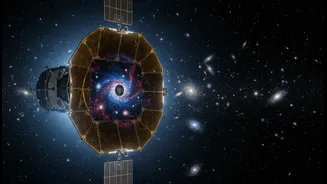
observatory boasts a primary mirror the same size as the Hubble Space Telescope's—2.4 meters in diameter. But its power lies in its perspective. Roman's Wide Field Instrument (WFI) will capture a patch of the sky at least 100 times larger than Hubble can in a single snapshot. This means that where Hubble might take hundreds of photos to mosaic a single galaxy, Roman can do it in just two. This wide-angle view is what makes it a game-changer, allowing it to rapidly map vast stretches of the universe and hunt for objects and phenomena that are rare or fleeting.
Unmasking the Universe's Dark Side
About 95% of our universe is made of mysterious substances we can't see: dark matter and dark energy. Roman is designed to attack these puzzles head-on. Dark energy is the name given to the unknown force causing the expansion of the universe to accelerate, while dark matter is the unseen stuff whose gravity holds galaxies together. The telescope will use several techniques to probe their effects. By measuring the precise positions and shapes of hundreds of millions of galaxies, it will map the distribution of dark matter through an effect called weak gravitational lensing. At the same time, by observing distant supernovae and charting the large-scale structure of the cosmos, Roman will provide the most precise measurements yet of how cosmic expansion has changed over time, giving us critical clues about the true nature of dark energy.
Taking a Census of Alien Worlds
While missions like Kepler and TESS have found thousands of exoplanets, they were most sensitive to planets orbiting very close to their stars. Roman will pioneer a different approach. Its primary method for planet-hunting will be gravitational microlensing. This technique relies on the warping of spacetime, an effect predicted by Einstein. When a star or planet passes in front of a more distant star, its gravity acts like a lens, briefly magnifying the background star's light. Roman will stare at the dense starfields in the center of our Milky Way, monitoring hundreds of millions of stars for these tell-tale flickers. This method is sensitive to planets of all sizes, including Earth-mass worlds, and at a wide range of distances from their stars. It will even be able to find 'rogue' planets that drift through space without a host star. Projections suggest Roman could discover over 1,000 planets via microlensing and another 100,000 using the more traditional transit method.
Charting the History of Galaxies
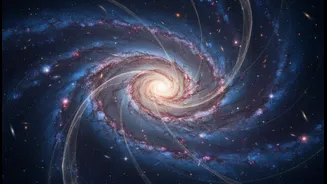
How did galaxies like our own Milky Way form and evolve over billions of years? Roman’s enormous surveys will create panoramic infrared maps of the sky, offering an unparalleled dataset for understanding galactic evolution. Its High-Latitude Wide-Area Survey will capture images and spectra from billions of galaxies, some so distant that we see them as they were in the early universe. This will allow astronomers to create a 3D map of the cosmos, charting how galaxies cluster together and how their structures have changed over cosmic history. The mission's Galactic Plane Survey will also map the dust and gas within our own Milky Way, providing a more complete picture of our home galaxy's structure and how new stars are born within it. The sheer volume of data—expected to be around 20 petabytes over five years—will be a treasure trove for astronomers for decades to come.