





Universal Health and Documentation
Before anything else, get your pet’s paperwork in order. This is non-negotiable for both trains and flights. You will need an up-to-date vaccination record, especially for rabies. A 'fit-to-travel' health certificate from a registered veterinarian is mandatory.
This certificate is time-sensitive and usually needs to be issued within 24 to 72 hours of your journey, so plan your vet visit accordingly. For international air travel, a microchip is also required, along with a No Objection Certificate (NOC) from the Animal Quarantine and Certification Service (AQCS). Always carry both original documents and copies.
Air Travel: The In-Cabin vs. Cargo Decision
Airlines in India have very specific rules for pet travel. The first thing to confirm is whether your pet can fly in the cabin with you or must travel in the cargo hold. This decision is almost always based on weight. Air India, for example, allows small pets (dogs and cats) up to 10kg, including their carrier, in the economy cabin. Pets heavier than this, up to 32kg, travel as checked baggage in the pressurized, temperature-controlled cargo hold. IndiGo has a stricter in-cabin weight limit of 7kg for the pet and carrier combined on domestic flights. Vistara's policy has varied, but generally involves pets travelling as checked baggage in the cargo hold. Always book your pet’s spot well in advance—at least 48-72 hours beforehand—as airlines only permit a limited number of pets per flight.
Flight Prep: The Right Carrier and Breed Checks
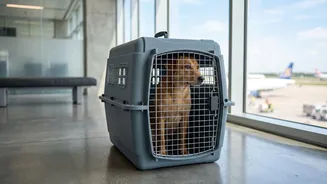
For in-cabin travel, you'll need a soft, ventilated, and leak-proof carrier that fits under the seat in front of you. Air India specifies dimensions of 17 x 10 x 9 inches. For cargo travel, a hard-sided, IATA-compliant crate is mandatory. The crate must be large enough for your pet to stand, turn around, and lie down comfortably. It must have a solid, leak-proof floor, adequate ventilation on four sides, and be secured with metal nuts and bolts, not just plastic clips. Crucially, check the airline's policy on brachycephalic (flat-faced) breeds like Pugs, Shih Tzus, and Persian cats. Many airlines, including Air India, will not transport these breeds in the cargo hold due to respiratory risks.
Train Travel: The First AC Coupe Rule
Indian Railways offers two main ways to travel with a pet. The most comfortable and popular method is to travel together in a First Class AC (1AC) compartment. However, you cannot simply book a ticket and bring your pet. You must book the entire 2-berth coupe or 4-berth cabin under a single PNR to ensure no other passengers can object. After booking your tickets, you must submit a written request to the Chief Reservation Officer at your boarding station, asking for the coupe to be allotted to you for pet travel. This is a request, not a guarantee, and depends on availability. Pets are strictly forbidden in all other classes like 2AC, 3AC, and Sleeper Class.
Train Prep: Booking at the Parcel Office
Unlike your own ticket, you cannot book your pet’s journey entirely online via the IRCTC website in all cases, though online booking for the 1AC coupe option is being rolled out. The traditional and still widely required step is to arrive at the station's parcel office at least 2-3 hours before departure. Here, you will present your confirmed 1AC ticket, the vet's health and vaccination certificates, and your pet. You will fill out a form and pay the luggage fee, which is calculated based on weight. The second option for train travel is booking your pet into a special 'dog box' in the brake van (the luggage car). This is a less desirable option as your pet travels separately from you in a crate.
Comfort and Safety During the Journey
Whether on a train or plane, your pet’s comfort is paramount. Ensure they are familiar with their carrier or crate before the travel day. Line it with an absorbent mat and a familiar blanket. Provide enough food and water for the journey, but avoid feeding them a large meal right before travel. For train journeys, you are responsible for your pet’s food and water. For flights, attach food and water dishes to the inside of the crate door, accessible from the outside. Most veterinarians and airlines strongly advise against sedating your pet for travel unless specifically prescribed, as it can interfere with their ability to regulate body temperature and balance. Always keep their leash and collar handy for any transit stops or necessary movements at the station or airport.