






The World's Largest Telescope
First, let's clear up a common misconception. The Square Kilometre Array (SKA) isn't a single, gigantic dish. It's a breathtaking international project to create the world's largest and most sensitive radio telescope by linking thousands of antennas together.
Coordinated by the SKA Observatory (SKAO) with its headquarters in the UK, the project is a marvel of global collaboration. The name refers to its ultimate goal: a total collecting area of one square kilometre, making it about 50 times more sensitive than any radio instrument built before. By using a technique called interferometry, signals from individual antennas are combined, allowing them to function as one colossal virtual telescope, capable of peering deeper into the cosmos than ever before.
A Tale of Two Continents
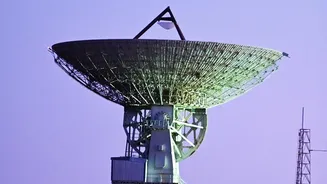
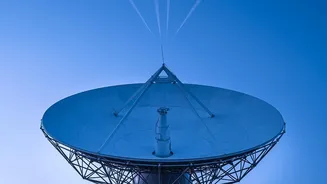
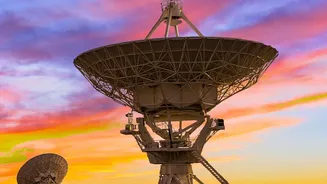
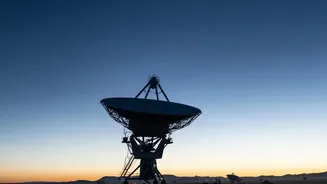
To catch the universe's faintest signals, you need absolute quiet. That’s why the SKA’s two arrays are being built in some of the most remote, radio-silent places on Earth. In the Karoo desert of South Africa, the SKA-Mid array will consist of nearly 200 classic 15-metre satellite dishes. These will survey the sky for pulsars, track gravitational waves, and even hunt for the complex molecules that could be precursors to life. Meanwhile, in the vast Murchison region of Western Australia, the SKA-Low array will feature over 131,000 small, Christmas tree-like antennas. These are designed to capture low-frequency radio waves that have travelled across billions of years, carrying secrets from the universe’s infancy. Together, these complementary arrays give astronomers an unprecedented view across the radio spectrum.
India’s Integral Role in the Cosmic Quest
India is not just a bystander in this global endeavour; it is a key player and a full member of the SKAO. With a rich legacy in radio astronomy, exemplified by the Giant Metrewave Radio Telescope (GMRT) near Pune, India was a natural partner from the project's early days. The nation has committed ₹1,250 crore to the construction and is making critical contributions. A consortium of Indian institutions, led by the National Centre for Radio Astrophysics (NCRA), was responsible for designing the Telescope Manager—the complex software system that will serve as the 'brain' and 'nervous system' of the entire observatory. Indian teams are also contributing to essential digital signal processing hardware and developing plans for a regional data centre to help manage the immense flow of information from the telescopes.
Decoding the Universe's Greatest Mysteries
So, what will the SKA actually look for? Its primary mission is to shed light on some of the biggest unanswered questions in physics and astronomy. A key goal is to observe the 'Cosmic Dawn'—the period in the first billion years after the Big Bang when the very first stars and galaxies lit up the universe. The telescope will also create vast 3D maps of cosmic hydrogen to study the mysterious forces of dark matter and dark energy, which together are thought to make up 95% of the universe. Furthermore, the SKA's incredible precision will allow it to test Einstein's theories of gravity under the most extreme conditions and detect the faint ripples in spacetime known as gravitational waves.
A Global Big Data Challenge
Observing the universe on this scale creates a data challenge of astronomical proportions. The SKA is expected to generate more data in a single day than the entire global internet traffic. Processing this deluge of information will require some of the fastest supercomputers on the planet. The data from the antennas in Australia and South Africa will be streamed to central processing facilities on-site before being distributed to a global network of regional centres for scientists to access and analyse. This aspect of the project is pushing the boundaries of computing, data storage, and network technology, with innovations that are expected to have a broad impact far beyond the field of astronomy.