


A Celestial Meeting in the Sky
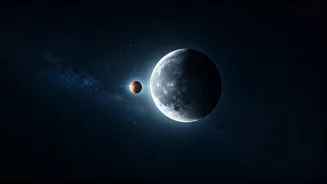
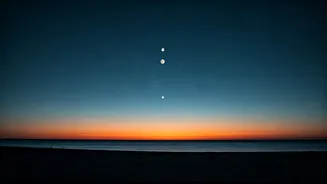
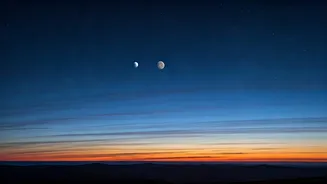
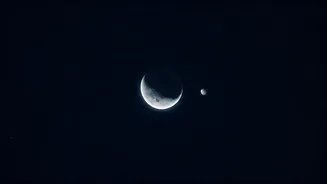
What exactly is happening on June 17? The event is known as a conjunction or a close approach. In simple terms, from our viewpoint here on Earth, the Moon and Venus will appear to be very near each other in the sky. While in reality they are hundreds
of millions of kilometres apart, their alignment creates a beautiful illusion. This isn't an incredibly rare event, but pairings involving a delicate crescent Moon and the brilliantly bright Venus are particularly photogenic. Venus is often called the 'Evening Star,' and on this night, it will have a striking partner. The Moon will be a very slim waxing crescent, meaning only a sliver of it will be illuminated by the Sun. This celestial duo will be visible in the constellation of Gemini, offering a stunning sight against the fading twilight.
When and Where to Look in India
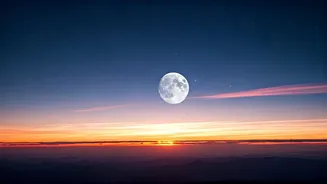
Timing and location are everything for sky-watching. This event will be easily visible across India. The best time to look will be shortly after sunset. As the sky begins to darken, cast your eyes towards the western horizon. Venus is impossible to miss; it will be the brightest point of light in that direction, shining with a steady, silvery glow. Just near it, you will spot the faint but distinct arc of the crescent Moon. You won't need a telescope or binoculars to see the pairing, as both objects are bright enough to be seen with the naked eye. For the best view, try to find a location with an unobstructed view of the western sky, away from tall buildings and the worst of city light pollution. A park, a terrace, or an open field would be ideal.
Tips for Smartphone Photography
You don't need a fancy camera to capture this cosmic moment. Your smartphone is more than capable if you follow a few simple tips. First, find a way to keep your phone steady. Resting it on a stable surface or using a small tripod will prevent blurry shots. Don't use the digital zoom, as it will reduce image quality; it's better to crop the photo later. Instead of just pointing and shooting, tap on the Moon or Venus on your screen. A small sun icon or slider should appear, allowing you to manually lower the exposure or brightness. This prevents Venus from looking like a giant white blob and helps bring out the faint details of the Moon. If your phone has a 'Night Mode' or 'Pro Mode,' now is the time to experiment with it. A little patience will reward you with a photo worth sharing.
For the Serious Photographer
If you're equipped with a DSLR or mirrorless camera, this event offers a fantastic canvas. A tripod is non-negotiable for sharp, long-exposure shots. A standard or short telephoto lens (50mm to 200mm range) is perfect for framing the duo along with some of the foreground landscape to add context. Switch to manual mode for full control. Start with a low ISO (100-400) to minimise noise, a relatively wide aperture (like f/4 or f/5.6) to gather enough light, and a shutter speed of around 1 to 4 seconds. Use your camera's timer or a remote shutter to avoid camera shake when you press the button. A fascinating detail to try and capture is 'earthshine'—the faint glow on the dark portion of the crescent Moon, which is caused by sunlight reflecting off the Earth and onto the Moon's surface. Bracketing your exposures can also be a wise strategy to ensure you get the perfect shot.