

A Tale of Two Moons
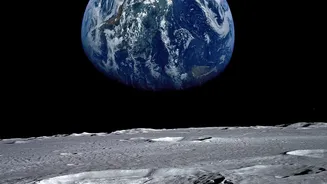
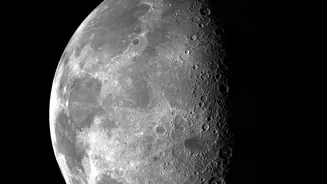
Anyone who looks up at the night sky is familiar with the 'man in the moon'— vast, dark plains of ancient volcanic rock called 'maria'. These features dominate the Earth-facing side, or near side. But the far side, hidden from our view until space probes
first imaged it in 1959, is a different world entirely. It is rugged, brighter, and almost completely covered in craters, with a crust that is significantly thicker and geochemically different. For decades, scientists have debated why this stark asymmetry exists, proposing theories from giant impacts to the gravitational pull of a young, hot Earth.
A Groundbreaking First: Samples from the Far Side
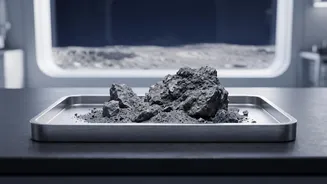
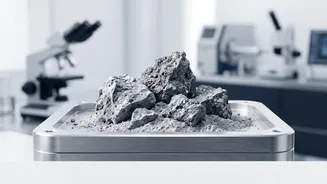
The game changed with China's historic Chang'e-6 mission, which in June 2024 successfully landed in the South Pole-Aitken (SPA) basin and returned the first-ever rock and soil samples from the lunar far side. The SPA basin is the largest, deepest, and oldest known impact crater on the Moon, a colossal scar from a collision billions of years ago. Scientists believed that samples from this unique location could hold the key to understanding the Moon's early history and the puzzle of its two-faced nature, potentially containing material excavated from deep within the Moon's crust or even its mantle.
What the New Farside Rocks Reveal
Analysis of the Chang'e-6 samples has yielded remarkable insights. One key finding relates to the composition of the crust. While the Moon's mantle appears relatively uniform, the crusts are very different. The far side crust contains more magnesium-rich material. Another study found that the farside rocks have a distinct chemical signature left by extreme heat. They contain a higher ratio of a heavier version of the element potassium, suggesting that a lighter version boiled off during a period of intense heat, likely caused by the giant impact that formed the SPA basin. This process stripped away volatile elements that might have otherwise fueled later volcanic activity, helping to explain why the far side has so few volcanic maria compared to the near side.
Uneven Heating and a Molten Past
New models, supported by the Chang'e-6 data, paint a picture of the Moon's fiery youth. Shortly after its formation, the Moon became tidally locked with Earth, which was still a scorching ball of molten rock. This meant the near side was constantly baked by Earth's intense heat, while the far side cooled more rapidly. One new study suggests this temperature difference created massive circulation patterns in the Moon's ancient magma ocean. Hotter magma flowed from the near side toward the far side, carrying lighter, magnesium-rich crustal materials with it. This process effectively piled up a thicker, more magnesium-heavy crust on the far side. Meanwhile, materials rich in heat-producing elements like potassium and thorium (known as KREEP) became concentrated on the near side, fueling the widespread volcanic activity that formed its iconic dark plains.
More Than Just a Different Face
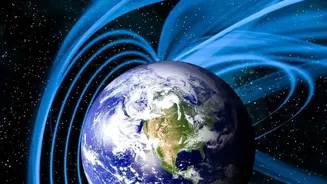
The differences aren't just geological. Another analysis of the Chang'e-6 soil showed that the two sides have experienced space weather differently. Because the near side periodically passes through Earth's protective magnetic field (the magnetosphere), it is shielded from the full force of the solar wind. The far side, however, is always exposed. This is reflected in the noble gases trapped in the lunar soil. Far-side samples show signs of being hit by faster, higher-energy solar wind particles compared to samples from the near side. This provides a preserved record of the Earth-Moon system's dynamics over billions of years, written into the very soil of our celestial neighbour.