
A New Window on Distant Worlds
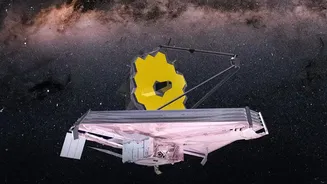
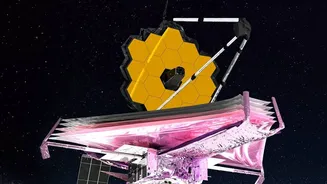
The James Webb Space Telescope (JWST) is a game-changer for astronomy. Its powerful infrared instruments allow it to do something remarkable: analyse the chemical makeup of atmospheres on exoplanets, which are planets orbiting stars other than our Sun.
It does this by capturing starlight that has been filtered through a planet's atmosphere as it passes in front of its star. Different molecules absorb light at specific wavelengths, leaving a unique chemical fingerprint. For scientists hunting for habitable worlds, one of the most exciting fingerprints is that of water vapour. Before Webb, we had hints, but the telescope's precision is turning speculation into concrete data, revealing just how common this vital molecule might be across the galaxy.
From 'Hot Jupiters' to Rocky Worlds
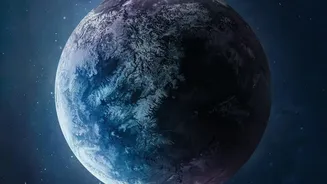
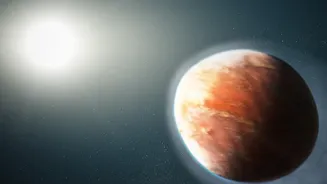
Webb's early observations confirmed water vapour on hot, gaseous exoplanets, but the more tantalizing discoveries involve smaller, potentially rocky worlds. One significant target has been GJ 486 b, a planet larger than Earth but scorched by its star, with temperatures around 430 degrees Celsius. Webb detected intriguing hints of water vapour there. Scientists are cautious, as the signal could potentially be coming from cool spots on the host star itself rather than the planet. However, if the water is confirmed to be from the planet, it would suggest that even hot, rocky worlds orbiting volatile red dwarf stars can hold onto an atmosphere, a crucial finding in the search for life. Another major discovery involved detecting water vapour in the planet-forming disk of a young star system called PDS 70. This means that water is available from the very beginning for rocky planets that might be assembling in that zone, similar to where Earth is in our solar system.
The Intrigue of 'Hycean' Worlds
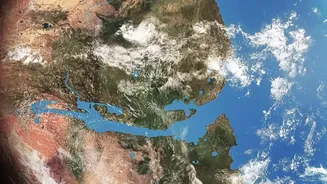
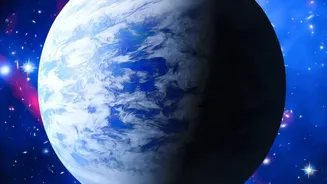
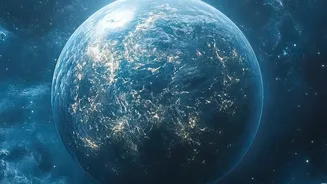
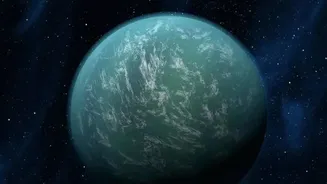
Perhaps the most compelling story is that of K2-18 b, an exoplanet 8.6 times the mass of Earth located 120 light-years away. Webb's investigation of its atmosphere revealed not only water vapour but also carbon-bearing molecules like methane and carbon dioxide. The combination of these gases, along with a lack of ammonia, strongly supports the hypothesis that K2-18 b could be a 'Hycean' world—a theoretical type of planet with a global liquid water ocean under a hydrogen-rich atmosphere. This opens up a new category of potentially habitable planets that are very different from Earth. While some scientists believe these worlds could be promising places to look for life, others caution that the interpretation is not yet settled, suggesting K2-18 b might be a gas-rich mini-Neptune with no defined surface. The debate highlights how Webb is pushing the boundaries of our planetary models.
More Than Just Water
Finding water is a monumental step, but it’s not the whole story. The presence of other molecules is just as important for assessing habitability. On K2-18 b, for instance, Webb's data showed a possible, though unconfirmed, trace of dimethyl sulfide (DMS), a molecule that on Earth is predominantly produced by life, specifically marine phytoplankton. This tantalizing hint has spurred intense follow-up research. Scientists are now focused on understanding the full chemical context. The mix of methane and carbon dioxide on planets like K2-18 b and another candidate, TOI-270 d, is itself a significant clue, pointing toward complex atmospheric and geological processes that are just beginning to be understood. Webb's ability to detect a whole suite of chemicals is what allows scientists to move from simply finding water to characterising entire planetary environments.