







A Nation on Pause
For one Thursday each November, the rhythm of South Korea changes. This year, on November 19, for a crucial 35-minute period from 1:05 p.m. to 1:40 p.m., the skies fell silent. No planes were permitted to take off or land at any airport in the country.
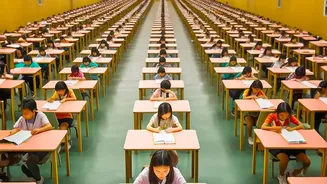
This nationwide flight ban is meticulously planned to coincide with the English listening comprehension section of the College Scholastic Ability Test, or Suneung. Any aircraft already in the air must maintain an altitude of at least 3,000 meters to ensure no engine noise can distract the hundreds of thousands of students below. But the silence isn't just in the air. On the ground, government offices and the stock market open an hour later to ease traffic congestion. Police officers are on standby to provide escorts for any student at risk of running late for the grueling eight-hour exam. Construction work is paused, and even military training exercises are halted to ensure absolute quiet near the 1,312 test centers.
What is the Suneung?
The Suneung is a marathon standardized test that is the culmination of 12 years of intense schooling. Introduced in its modern form in the early 1990s, the exam covers multiple subjects including Korean, Mathematics, English, Korean History, and other electives. For many, this single day is the most critical academic event of their lives. A high score can open doors to the country’s most prestigious 'SKY' universities (Seoul National, Korea, and Yonsei), which is widely seen as the primary path to a successful career, high social standing, and even favorable marriage prospects. The stakes are so high that many students who are unhappy with their results will spend another full year studying in private 'cram schools' known as hagwon to retake the exam. This year, over 35% of the 551,864 registered candidates were graduates retaking the test.
The Weight of a Nation's Hopes
The extreme measures taken on Suneung day are a direct reflection of the immense pressure placed on students. This societal focus on academic achievement, often called 'education fever', has deep historical roots in a country that saw education as the primary engine for its rapid economic recovery after the Korean War. For generations, a university degree has been viewed as the most reliable path to social mobility. This has created a hyper-competitive environment where students often study for up to 16 hours a day. While this system has produced some of the world's top-performing students, it has also faced criticism for contributing to immense stress, anxiety, and unhappiness among young people. The financial strain on families, who often spend millions of won on private tutoring, is also a significant concern.
A Collective Ritual
Beyond the pressure, Suneung day is also a powerful display of national solidarity. It's a day filled with rituals and collective support. In the morning, it's common to see younger students gathered outside test centers, cheering on their seniors with signs and chants. Parents flock to temples and churches, many timing their prayers to the exam's schedule, wishing for their children to remain calm and do their best. Families have their own traditions, from giving students sticky rice cakes called 'tteok' or a candy called 'yeot'—symbolizing the hope that good scores will 'stick'—to avoiding slippery foods like seaweed soup. It is a cultural phenomenon that demonstrates a society's profound investment in the dreams and futures of its youth.
New Fears and an Uncertain Future
This year's exam was held amid heightened concerns about cheating, following a recent scandal where the top scorer in a national tax accountant exam admitted to using a hidden camera and an AI system. In response, authorities implemented unprecedented security measures, including deploying thousands of additional personnel, inspecting eyeglasses, restricting personal stationery, and even using nationwide emergency mobile alerts to detect hidden phones. The incident has intensified the ongoing national debate about the Suneung's role in modern society. While many acknowledge its part in driving the nation's success, there is a growing call for reforms to ease the all-or-nothing pressure and move toward a more holistic evaluation system that values more than a single day's performance.