

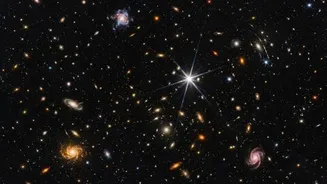
A New, Sharper Look at Cosmic Dawn
For decades, astronomers have worked with a relatively neat story about the early universe: after the Big Bang, things were dark and simple for a long time. Then, gradually, the first small, simple galaxies began to form, slowly growing more complex over
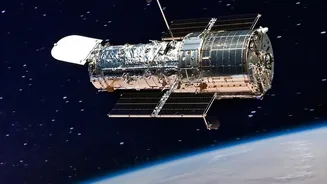
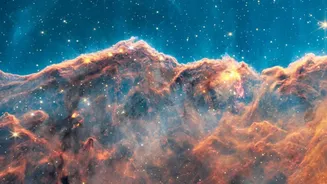
billions of years. But the latest generation of telescopes, most notably the James Webb Space Telescope (JWST), is painting a much messier and more fascinating picture. These instruments can capture incredibly faint infrared light that has travelled for over 13 billion years, effectively acting as time machines. The result is stunningly detailed images of galaxies as they existed at the dawn of time—and they are not what we expected.
The 'Impossible' Early Galaxies
Across multiple deep-sky surveys, astronomers are repeatedly finding galaxies that are shockingly bright, massive, and chemically mature for their age. For instance, a galaxy confirmed at a redshift above 14, named JADES-GS-z14-0, existed when the universe was less than 300 million years old. According to prevailing models, a galaxy this young should be small and relatively dim. Instead, it is surprisingly luminous and already contains elements like nitrogen, which were thought to take much longer to produce through cycles of star birth and death. These aren't isolated flukes; JWST keeps finding these 'impossible' objects, suggesting that star formation in the early universe was far more efficient and rapid than our theories predicted.
Rethinking Galactic Building Blocks
These discoveries are forcing a fundamental rethink of galaxy formation. One emerging puzzle is a category of objects nicknamed 'Little Red Dots' (LRDs). These are extremely compact but bright objects seen in the early universe. Scientists are debating what they could be. Are they the cores of nascent galaxies hosting supermassive black holes much earlier than anticipated? Or could they be a new type of ancient globular cluster, dominated by super-massive stars? Recent studies suggest some LRDs may indeed be active black holes in dusty, starburst galaxies, which would rewrite the timeline for when these cosmic engines first roared to life. Another study used machine learning to find new, rare quasars—the intensely bright cores of distant galaxies—which act as crucial 'baby pictures' of supermassive black holes.
A Universe in a Hurry
The pattern extends beyond individual galaxies to the grand structure of the cosmos. Astronomers have found a galaxy cluster, XLSSC 122, with a core of dark matter so dense that it seems too concentrated for its age. Galaxy clusters are the largest known gravitationally-bound structures, and they are supposed to take billions of years to assemble. Finding one so developed so early on adds to the evidence that the early universe was in a hurry. These findings don’t break our understanding of the Big Bang, but they do indicate that key parts of the story are missing. The universe, it seems, was far more capable of building complex, massive structures right from the beginning than anyone had imagined.