






The Search for the Lost Spoon
Picture this: you are carefully crafting a complex masala or baking a delicate cake. The recipe calls for a precise quarter-teaspoon of a potent spice. You reach into the notoriously chaotic cutlery drawer, fumbling past wine stoppers and forgotten gadgets,
only to find every size but the one you need. This moment of mild panic is a universal experience in home kitchens. It disrupts your rhythm, dirties more utensils, and can even compromise the final dish. The simple habit of keeping one complete set of measuring cups and spoons together is less about rigid organisation and more about preserving the joy and flow of cooking. It’s a small change that eliminates a common source of stress and wasted time, letting you focus on the ingredients and the process, not the frantic search for a missing tool.
The Secret to Consistent Cooking
Beyond the obvious benefit of tidiness, using a single, dedicated measuring set is crucial for consistency. You might assume a cup is a cup and a spoon is a spoon, but that's not always true. There are no strictly enforced accuracy standards for consumer-grade measuring tools, and small variations in manufacturing can mean that the 'cup' from one set holds a slightly different volume than a cup from another. Even within the same country, different brands can have slight discrepancies. These minor differences can become significant, especially in baking, where the scientific ratio of flour, sugar, and leavening agents is key to success. A few extra grams of flour can turn a light, airy cake into a dense one. By sticking to one set, you create your own standard, ensuring that your 'one cup of flour' is the same today as it was for last week's triumphant bake. This consistency is the foundation of reliable and repeatable results.
Choosing Your Champion Set
Since this will be your go-to set, it’s worth choosing wisely. Look for a complete set that includes the most common sizes: 1/4 tsp, 1/2 tsp, 1 tsp, and 1 tbsp for spoons, and 1/4 cup, 1/3 cup, 1/2 cup, and 1 cup for dry ingredients. Stainless steel is often recommended over plastic as it is more durable, won't warp or crack, and the measurement markings are less likely to fade with repeated washing. Some cooks even prefer two sets: a narrow set of spoons that can easily fit into spice jars and a standard round set for liquids and other tasks. Whatever your choice, the key is to have a complete and reliable set that you can depend on. The initial goal is to eliminate the variables that come from mixing and matching tools from different manufacturers and eras.
Smart and Simple Storage Solutions
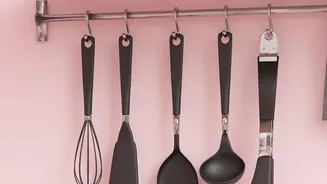
Keeping the set together doesn't mean you must use the flimsy ring it came on, which can be clumsy. A popular and effective solution is to use the inside of a cabinet door—a frequently underused piece of kitchen real estate. By installing small hooks, either screwed in or using renter-friendly adhesive ones, you can hang each cup and spoon individually. This keeps them organised, visible, and easy to grab. You can even add labels above each hook to see at a glance which one you need and, more importantly, which one is missing. If you prefer to keep them in a drawer, use a small divider to create a dedicated zone just for your measuring set. Another option is to store them upright in a small container or jar on the counter next to your other frequently used tools, keeping them within arm's reach while you work.