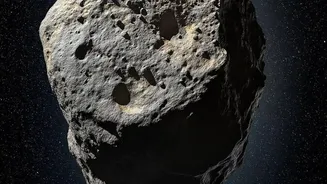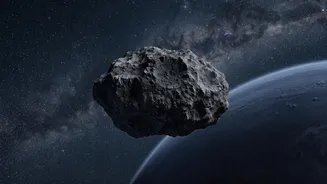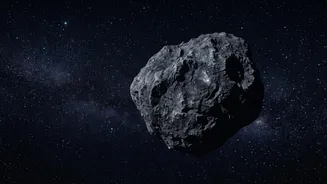





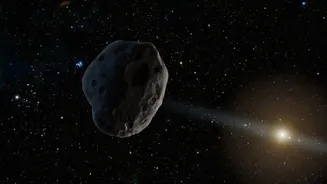
For months, a mysterious object has been looping around our planet, a temporary companion on our journey around the sun. This sparked a quiet debate among sky-watchers: was it a natural space rock or a forgotten piece of human-made space junk?
Meet Earth's Temporary 'Minimoon'
The object
at the center of the discussion is 2026 QQ8, a small body measuring only about two meters across. It was first spotted in August 2026 by Hungarian astronomer Krisztián Sárneczky. After its discovery, astronomers traced its path and realized Earth's gravity had captured it back in April 2026, pulling it into a wide, looping orbit. This phenomenon makes it a 'minimoon'—a term for a natural object temporarily captured by our planet's gravity. These events are rare but not unprecedented; only a handful have ever been confirmed. 2026 QQ8's visit is brief in cosmic terms; it's expected to remain in Earth's orbit until early 2027 before our planet's gravity lets it go, sending it back into its own orbit around the sun.
Rock or Rocket? The Identity Question
The initial uncertainty about 2026 QQ8's origin is a common challenge in modern astronomy. As we launch more missions to the Moon and beyond, the amount of space debris, like discarded rocket boosters, also increases. These artificial objects can end up in orbits that mimic those of natural asteroids, sometimes leading to misidentification. The key question for astronomers was whether 2026 QQ8 was a leftover from a past space mission or a genuine asteroid. The Minor Planet Center, the global body responsible for logging such discoveries, initially noted that no link to a known artificial object could be found but urged further study to be certain. Its trajectory was unusual, but not impossible for a natural object. This ambiguity required a closer look using more powerful tools.
How Science Delivered the Verdict
To solve the mystery, astronomers used a combination of techniques. First, they performed detailed follow-up observations using large telescopes. By carefully tracking the object's orbit, they can be compared to the trajectories of all known rocket launches. More importantly, they used spectroscopy. This method involves analyzing the light that reflects off the object's surface. Different materials reflect light in unique ways, creating a sort of chemical fingerprint. Natural space rocks, which are typically made of silicate minerals and metals, have a distinct spectral signature. In contrast, artificial objects are often covered in materials like stainless steel or specific types of paint, which show up differently in spectroscopic analysis. The light signature from 2026 QQ8 matched that of a natural, rocky body, allowing the Minor Planet Center to officially confirm its status as a natural space rock.
Why This Confirmation Matters
Confirming that 2026 QQ8 is a natural asteroid is more than just a matter of cosmic bookkeeping. It's a crucial part of planetary defense. Organizations like NASA's Planetary Defense Coordination Office are tasked with detecting, tracking, and characterizing near-Earth objects (NEOs) to assess any potential impact risk. Knowing the difference between a dense, solid asteroid and a hollow, lightweight piece of space junk is vital for accurately predicting trajectories and potential hazards. While 2026 QQ8 poses no threat—at its closest, it remains about 1.5 times farther away than our Moon—the process of identifying it sharpens the skills needed to monitor other objects that might come much closer. Each confirmation, big or small, reinforces our ability to act as responsible guardians of our small corner of the solar system.