







A Planet on an Extreme Journey
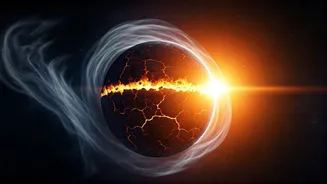
Meet HD 8060b, a gas giant about four times the mass of Jupiter orbiting a sun-like star. But this is no stately, circular path like the planets in our solar system. HD 8060b follows a wildly eccentric, stretched-out orbit that looks more like a comet's.
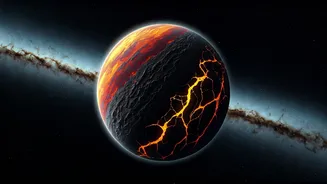
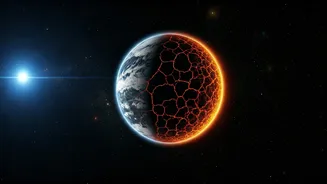
Most of its 111-day year is spent far from its star, in the cold depths of space. Then, for a brief, frantic period, its orbit brings it incredibly close to its stellar host, subjecting it to an intense blast of heat and radiation before it swings back out into the darkness. It's a rhythm of extreme seasonal change, going from frigid to fiery in a matter of hours.
A Ringside Seat to Atmospheric Chaos
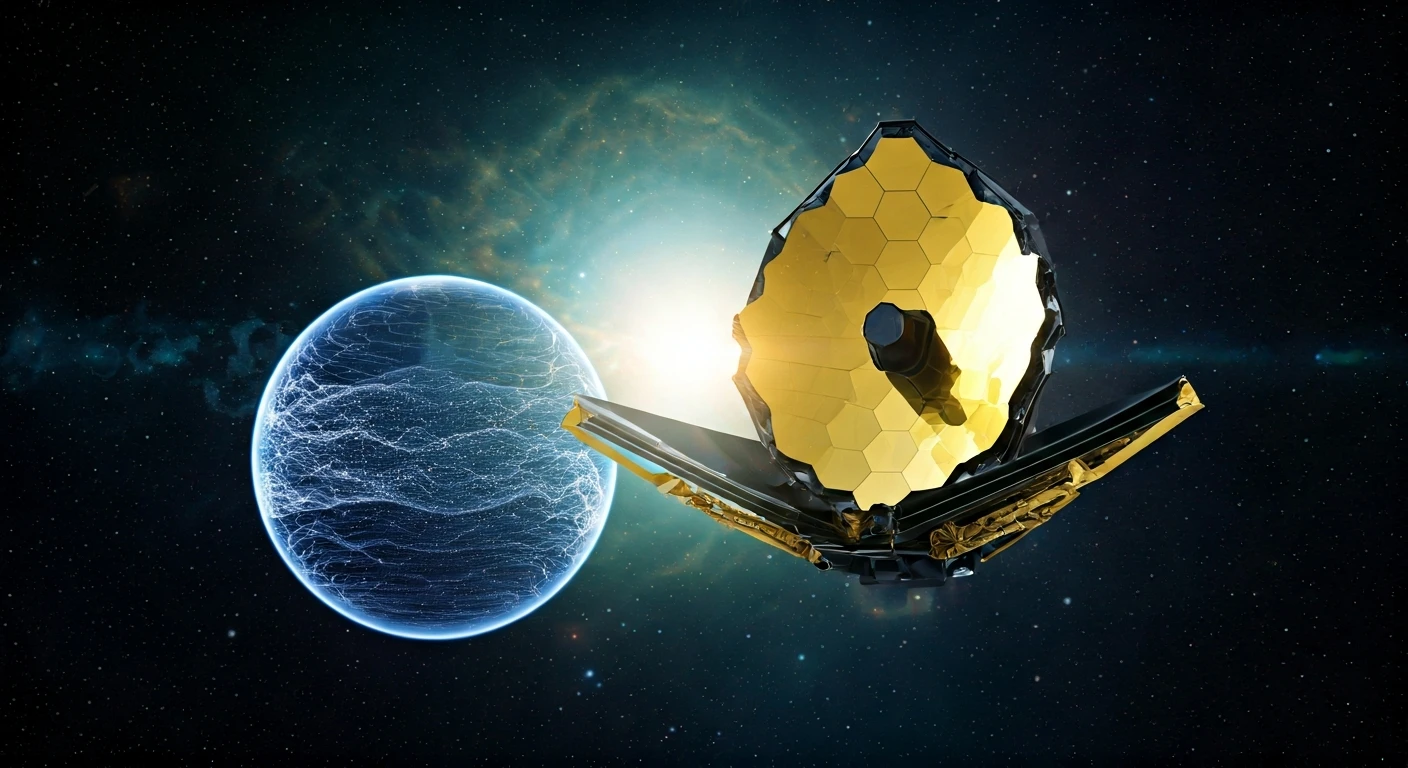
This dramatic swing in temperature makes HD 8060b an incredible target for astronomers. Using the powerful James Webb Space Telescope (JWST), scientists were able to watch the planet as it made its closest approach to its star. What they saw was a world in turmoil. The planet's temperature shot up by thousands of degrees in a very short time. Thanks to Webb's advanced spectroscopic instruments, which split light to read chemical and thermal information, scientists can do more than just take the planet's temperature. They can watch its atmosphere change in almost real time, observing how clouds form and dissipate and how different molecules in its atmosphere react to the sudden, intense blast of energy.
The Ultimate Atmospheric Stress-Test
This is where HD 8060b becomes invaluable to science. Most computer models that simulate exoplanet atmospheres assume a state of equilibrium, where conditions are relatively stable. They are excellent for predicting the climate of a planet with a regular, stable orbit. But they aren't designed to handle the kind of rapid, violent change seen on HD 8060b. The planet acts as a natural laboratory for pushing these models to their breaking point. By feeding the real-world data from JWST into their simulations, scientists can see where their models succeed and, more importantly, where they fail. It’s like crash-testing a car; you learn the most about its safety features not when it's parked, but when it's subjected to extreme forces.
Refining the Search for Other Worlds
Why does getting the physics right for a bizarre, scorching-hot gas giant matter? Because the same fundamental principles of atmospheric physics govern all planets. The process of a star's radiation stripping away an atmosphere, known as atmospheric escape, is a crucial factor in determining a planet's long-term evolution and habitability. Mars, for example, is thought to have lost its once-thicker atmosphere and liquid water over billions of years due to similar processes. By testing their models on an extreme case like HD 8060b, scientists can build more robust and reliable simulations. These refined models will be essential in the search for life elsewhere.
From a Roasted World to Habitable Worlds
Ultimately, one of the grand goals of exoplanet science is to find and characterize Earth-like planets in the habitable zone—the region around a star where liquid water could exist on a planet's surface. When we eventually find these worlds, our understanding of their atmospheres will be based entirely on the light we can capture from them, interpreted through computer models. If those models are inaccurate, we could misinterpret the signs. A faint chemical signature could be mistaken for evidence of life, or a truly habitable world could be overlooked. By studying the wild, chaotic atmosphere of a roasted planet like HD 8060b, we sharpen the very tools we need to one day identify a second Earth.