
Earth: Our Only Blueprint for Life
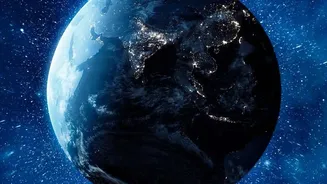
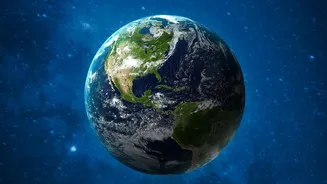
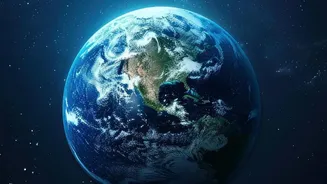
In the immense cosmic library, Earth is the only book we have that describes a planet teeming with life. This simple fact makes it the single most important reference for astrobiologists. Scientists operate on the principle that to find life elsewhere,
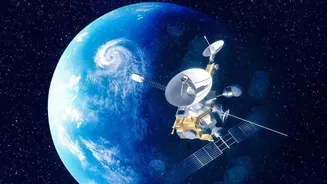
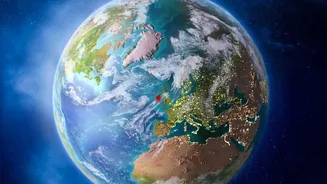
we must first deeply understand the conditions that allowed it to arise and thrive here. By treating Earth as an exoplanet, researchers can test their methods and assumptions. Projects use our planet to simulate what a distant, life-bearing world might look like to our most advanced telescopes. This involves studying how Earth’s atmospheric gases, such as oxygen, methane, and ozone, create a unique chemical fingerprint—or biosignature—that points to biological activity. The entire history of our planet, from its early, oxygen-poor state to the vibrant world we see today, provides a range of potential models for what a habitable exoplanet might look like at different stages of its evolution.
Lessons from Life in the Extremes
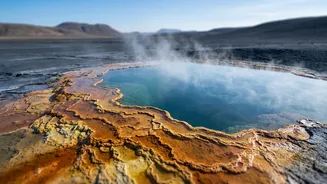
For decades, scientists thought life required gentle, sunlit conditions. But the discovery of extremophiles on Earth has shattered that notion. These are organisms that thrive in the planet’s most hostile environments: volcanic vents on the ocean floor, highly acidic rivers, bone-dry deserts, and even frozen Antarctic lakes. These resilient life forms show that biology is far more adaptable than once imagined. For astrobiologists, extremophiles are crucial analogs for what life might look like on other worlds. The existence of psychrophiles, or cold-loving organisms, suggests that life could potentially survive in the subsurface oceans of icy moons like Jupiter’s Europa or Saturn’s Enceladus. Similarly, microbes that live in volcanic areas on Earth, like Spain's Río Tinto, provide a model for how life might have existed on ancient Mars, which was once volcanically active and wet. Studying these organisms helps scientists broaden the definition of a 'habitable zone' and informs where to point our rovers and telescopes.
Reading the Story in the Rocks
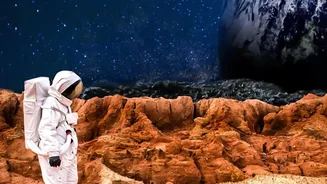
Geology provides a tangible history of Earth's habitability, and these lessons are directly applied to our robotic exploration of other planets, especially Mars. Rovers like Perseverance and Curiosity act as robotic geologists, analyzing Martian rocks to piece together the planet's past. They look for minerals like clays and carbonates, which form in the presence of water—a key ingredient for life as we know it. For example, the discovery of diverse volcanic rocks in Mars' Jezero Crater suggests prolonged volcanic activity, which could have supplied energy and chemical nutrients for ancient microbial life. Furthermore, identifying specific minerals like silica is exciting because on Earth, silica is excellent at preserving fossilized evidence of ancient microbes. By understanding how Earth's rock record has preserved signs of early life, scientists know exactly what to look for when sifting through the sands of Mars.
Decoding Alien Atmospheres
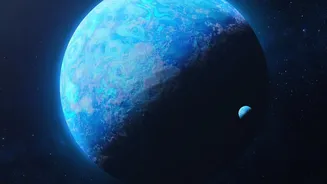
Perhaps the most promising method for finding life on distant exoplanets is to analyze the chemical composition of their atmospheres. Using powerful instruments like the James Webb Space Telescope (JWST), astronomers can study the light that passes through a planet's atmosphere as it transits its star. Different gases absorb light at specific wavelengths, creating a barcode-like spectrum that reveals the atmosphere’s contents. Here again, Earth is the guide. Our atmosphere is rich in gases like oxygen and methane, which are produced in vast quantities by living things. Finding a similar combination on another rocky planet would be a powerful hint of life. The JWST has already begun this work, detecting methane, carbon dioxide, and even hints of dimethyl sulphide—a gas produced exclusively by life on Earth—in the atmosphere of the exoplanet K2-18b. While not definitive proof, these atmospheric biosignatures are a critical piece of the puzzle, and our understanding of Earth’s own atmosphere is what makes the search possible.