



Seeing the Universe in a New Light
Imagine light as a broad spectrum, with the rainbow of colours we see being just a small slice. Beyond the red end of that rainbow lies infrared light. Humans can't see it, but we feel it as heat. Many celestial objects that are too cool or dim to shine
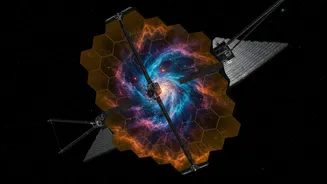
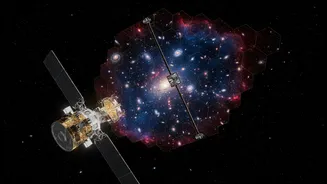
brightly in visible light, like young planets or faint stars, still glow in the infrared. However, much of this infrared light is absorbed by water vapour and carbon dioxide in Earth's atmosphere, making it impossible to observe from the ground. To capture this hidden light, we must go to high, dry places or, even better, to space. Telescopes like the James Webb Space Telescope (JWST) are designed specifically to detect these infrared wavelengths, opening an entirely new window to the cosmos.
Piercing Through Cosmic Dust
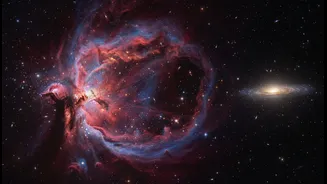
One of infrared astronomy’s greatest powers is its ability to see through the dense clouds of cosmic gas and dust that block visible light. These nebulae, which appear as dark patches to optical telescopes like Hubble, are often the very places where new stars and planets are being born. Visible light, with its shorter wavelengths, gets scattered by dust particles, but the longer wavelengths of infrared light can slip past more easily. This allows astronomers to peer deep into these stellar nurseries and witness the birth of stars and planetary systems, a process previously shrouded in mystery. Recent images from the JWST, for example, have revealed stunning details of protostars and their outflows within systems like FS Tau, showcasing star formation in incredible clarity.
A Window to the Beginning of Time
Because light takes time to travel across the vastness of space, looking at distant objects is like looking back in time. But there's a complication: the universe is expanding. This expansion stretches the light from the most distant galaxies, shifting it from visible and ultraviolet wavelengths into the infrared part of the spectrum—a phenomenon called redshift. This means the light from the very first stars and galaxies that formed after the Big Bang reaches us today as infrared light. By using infrared telescopes, astronomers can capture this ancient light and study the dawn of the universe. It’s our only way to directly observe how the earliest cosmic structures came into being.
The Secrets of Other Worlds
Infrared technology is also a crucial tool in the search for life beyond Earth. When an exoplanet passes in front of its star, a tiny fraction of the starlight filters through the planet's atmosphere. By analysing this light with infrared spectrographs, scientists can detect the chemical fingerprints of different molecules, such as water, methane, and carbon dioxide. These observations provide vital clues about an atmosphere's composition, temperature, and climate. The James Webb Space Telescope has already demonstrated its power in this field, studying the atmospheres of distant worlds and helping scientists understand the conditions on planets orbiting other stars. This technique is one of our most promising methods for identifying potentially habitable worlds.
The Webb Telescope Revolution
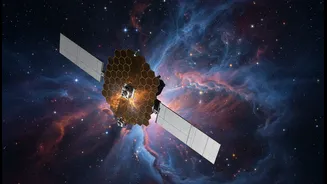
No instrument better exemplifies the power of infrared astronomy than the James Webb Space Telescope. Building on the legacy of its infrared predecessors like the Spitzer Space Telescope, JWST's sensitivity is revealing the universe in unprecedented detail. For its fourth anniversary, NASA released breathtaking images of the galaxy Centaurus A. Where the Hubble saw only dark lanes of dust, Webb’s infrared vision pierced through to reveal a vibrant tapestry of individual stars. This has allowed astronomers to map the galaxy's history of star formation, which was sparked by a colossal merger two billion years ago. By observing the motion of gas near the galaxy's central supermassive black hole, Webb is providing answers to long-standing questions about how galaxies evolve.